
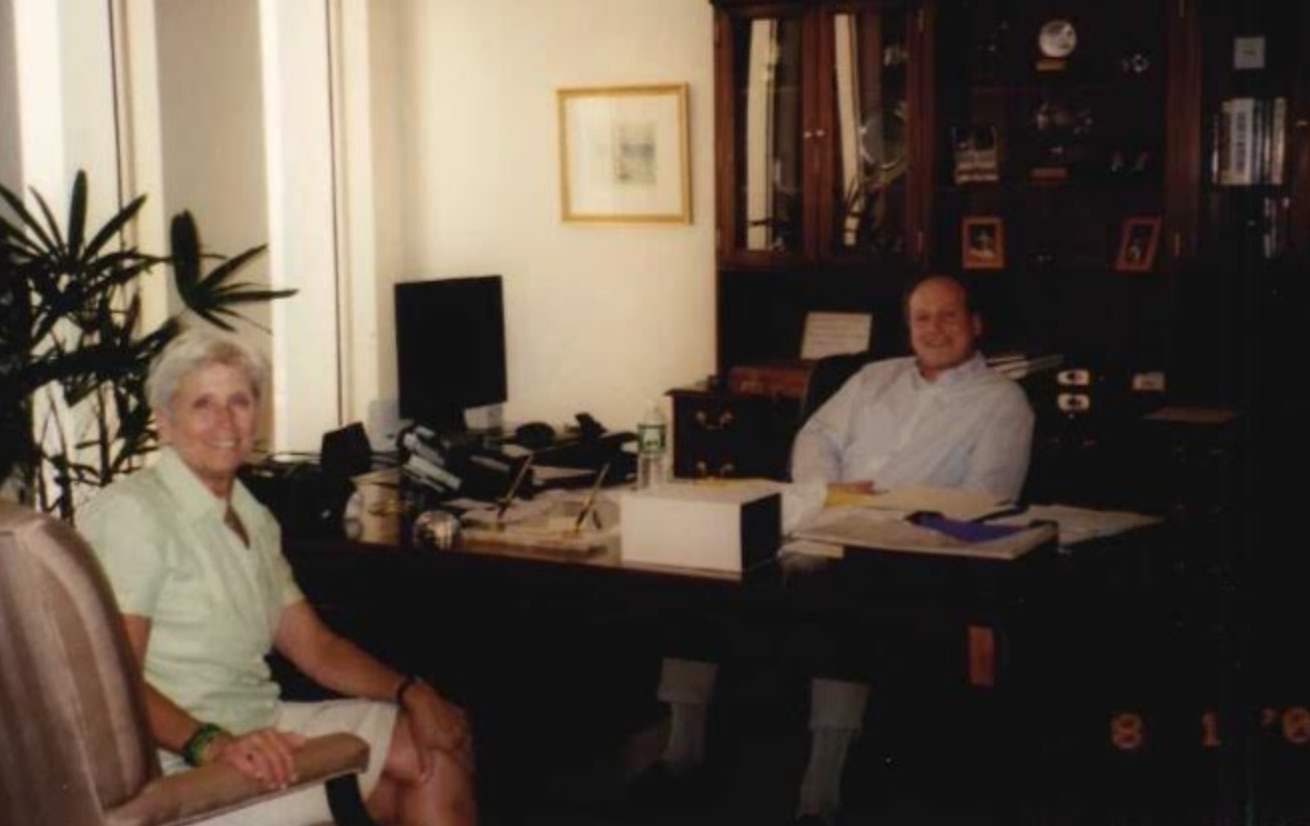
Bill McMahon, a finance executive who worked at the World Trade Center, recalls his life before, during, and after September 11, 2001, offering a firsthand account of the evacuation, the heroism he witnessed, and the enduring impact of that day on his personal and professional life.
This interview is part of an oral history project undertaken by Alex Bower-Leet in affiliation with the University of Kentucky.
I was born in Minnesota, grew up in Hastings, Minnesota, which is a small river town, which is about 30 miles south of the Twin Cities. I’m one of nine children. I Went to Hastings High School, graduated, went to the University of Wisconsin, got a degree in economics, and then went to work for Merrill Lynch and Company in St. Paul, Minnesota. I was with them for about three or four years and then got into management at Dean Witter Reynolds in 1984. And then from 1984 until 1991, I managed a number of different offices in the Twin City area. Then I got promoted to a branch in Atlanta. And then I was the manager of the Atlanta branch from 91 to 97. And then in 97, I was promoted to head training for what was then Morgan Stanley Dean Witter up in New York City in the World Trade Center. So I started working in the World Trade Center in 1997, obviously until 9/11. 2001.
I wanted to get out of Hastings, Minnesota. And so that was one of the ways to get out of there. I think secondly, economics is really about behavior. And to me, learning about that was very interesting. And I had an opportunity to get into finance as a stockbroker financial advisor with Merrill Lynch at the time. And so it gave me an opportunity to become very, trying to think the word, I was always interested in current events. And so if you understand current events and what’s going on in the world, it can help you help investors manage their money, right? So that to me was the real interesting part. The finance part came relatively easy for me. Math was always something that came easy to me so I could help them with that type of stuff, which was nice. But to me, it was more about helping people achieve whatever goals they had and really truly forming a partnership with those people. So that’s probably what I enjoyed the most about it was the people part of it and helping people achieve their goals. Because if you can help people with their finances, you can impact their life forever, right? And so to me, that was a pretty meaningful thing to be able to do.
Life Before 9/11
In my life before 9/11 I was living in the suburbs, with two children, a boy and a girl, baseball games and soccer practice and all those kinds of things we did. When we lived in Atlanta, we lived in a gated community and all that kind of fun stuff. And so our kids, it was a very kind of, classic American life, I should say. And, I never imagined I’d be working in New York City. It never really even dawned on me. And I remember when they called me up to interview me to run training for the firm, I thought, they’re just doing this to be nice, right? And then I got a call one day and they said, well, you’re going to New York City to work in the World Trade Center, which is where our headquarters were at the time for wealth management. And so we came up here and we bought a house in Basking Ridge, New Jersey, which when you kind of buy something in New Jersey and you work in New York City, you find a place that’s close to a highway or a train station so you can get in and get out relatively easily.
For those of you who didn’t grow up in or live in New Jersey, you probably won’t quite understand this as much, but in New Jersey, everything is an exit, right? So we’re exit 33 off of 78. Okay. Once I say that to somebody that lives in New Jersey, they know exactly where I live, right? I don’t have to say Basking Ridge. I don’t say you just tell them what exit you live off of what highway. And so it’s right at the crossroads of 287 and 78. And so for me, I would drive to the exchange place, take the path, which is not in the New York subway. It’s part of the Port Authority. And it was just a train that would go from Exchange Place, which is basically Jersey City, to the bottom of the World Trade Center. And so that’s basically, I drive my car, park it there, and then go right over to the World Trade Center and go up to work. So my life then, once I got up to here, up to New York City, was getting up early in the morning, getting in my car by about 5:30, 4 to 6, because you had to avoid the traffic, getting into exchange place, parking my car, taking the path over to the World Trade Center, go up the three or four different escalators, the main huge elevator up to 44, you’re transferring the small. The time it took me to get once I got in the World Trade Center was about another 10 minutes before I actually got to my office because of all the different, you know, elevators and escalators and stuff you had to take.
Commuting is a big deal up here, right? So it’s trying to figure out how you can make your commute the least disruptive. And what I mean by that is the least possible thing that could go wrong, right? So, by driving to a change place, I only had to take one path and the path always ran every few minutes. You didn’t have to worry about it. Then I’d get in my car and take my car. So I had all that flexibility. If I took a train in, I’d have to go park my car in either Basking Ridge or one of the train stations along the way. And then I would get a train and I would go into Penn Station. Then I’d take a subway from Penn Station down to the World Trade Center. That all took way too long, right? And there were way too many. possibilities. New Jersey Transit is very well known for its inability to run trains on time. And so to figure out a way to try to make it as least challenging as you possibly can to get there. Because it does, the commute’s always an hour. No matter, I don’t care how you go into New York City after 9/11 when I worked up in Midtown, I still drove and I drove all the way into the city and then parked my car a block away from the office. No matter how good everything worked, the minimum was still an hour, right? So it’s an hour in our home. And then, you know, a little bit of rain, a little bit of snow, an accident, blah, blah, blah. It could be two hours, 3 hours to get home.
So on that day, I was scheduled to have dinner that night with the retired chairman of Dean Witter named Stretch Gardner. The reason I bring that up is that I didn’t drive my car on that day. I had a car service bring me to Exchange Place because I wasn’t going to drive home that night. So I was going to have a car take me home after dinner. So I had a car drop me off at Exchange Place. Now remember, this is the first day after the holiday, right? So, and it’s an absolutely gorgeous, classic New York fall day, crystal clear blue skies, weather was fantastic. So I take the path over, go up to the office, and then I meet a group of people that we normally will have breakfast with in the cafeteria. So we go down, we have breakfast in the cafeteria. Just a typical day, right? And we’re just coming back from vacation, everything, everybody’s kind of catching up on where they went and what’s going on and beginning to plan our day.
And so my offices were on the 69th floor of the World Trade Center and it looked out over my office to the Statue of Liberty. And so these are very thin windows. And so I remember talking to someone named John Marshall. You remember these little facts when you go through this because it’s so kind of just a shocking part of your memory, right? So I remember talking to John Marshall at the time. And as I’m talking to him, I saw this debris go by my window. Now we’re in the South Tower on the 69th floor. And so if you remember where the first plane hit and how it came around and hit and it blew everything from the first tower around the second tower like this. So I’m looking out and I see this debris go by that’s on fire. And I’m like, well, I’ve seen helicopters go by and airplanes go by, but I’ve never seen anything on fire go by my window.
So I tell John, I got to go. I was the regional director at the time of the New York region. So I walked over to my counterpart who’s the regional director in the Northeast, which is Boston and all that kind of stuff. So I walked into his office named John Wilson. And I said, did you see that? And he goes, yeah, I don’t know what’s going on. And so we kind of gather and begin to kind of talk about what’s going on. And I mean, it wasn’t like the internet today where you can just type it in and go, this is what’s going on, right? It didn’t, the phone, the cell phones at those times were not little handheld computers. They were just true cell phones, right? So for us, we really didn’t know what was going on. And I’ll take you one step back. There’s a guy named Rick Rescorla. So Rick was the head of security for Morgan Stanley Dean Witter down at the World Trade Center. Rick was the one who constantly drilled into our heads that we have to get out of the building because nobody’s coming to save you. There are no fire trucks or ladders long enough. None of that’s the first thing you need to do is get out of that building.
And so at the time, there was myself, my counterpart, John Olson, our two assistant regional directors. One was Ed Sullivan, the other was Jeff Stannard and then our three assistants, and then our one kind of admin person who helped us with different types of things. So that was the group that was in that part of the 69th floor. So we all kind of gathered, kind of talking about what to do, trying to figure it out. And we said, you know what, we need to go to the stairwell and start going down the stairs. And there was no announcement. There was nothing over the PA. Nobody came and said, you know, hey, everybody should leave the building immediately. What we thought was it was a commuter jet or plane or something that ran into the first building, right, into One World Trade. And we always thought that was always a possibility because you always see planes going by and stuff all the time when you’re up there. You thought, well, I guess one of them hit one finally. We all go to the stairwell and Patty Montecino, who was John Olson’s assistant, wasn’t there. So I’m like, so I got to go find out where Patty’s at. So I go back there to find out where Patty’s at. I start talking to Patty. She gets out, starts walking, says her high heels on. I’m like, Patty, you can’t go down all these stairs to your high heels. I can go put your tennis shoes on. She goes, so we’re fiddling around. And by the time Patty and I get done doing that, you know, there aren’t that many people left in the stairwell because people are starting to walk down, right?
So we get down to the 44th floor, which is the skyway in the World Trade Center. So the World Trade Center, the way you’d go up, it even works that way today in the new World Trade Center. You go up these huge elevators to another skyway, which is a two floor kind of lobby. And then you get off into that lobby and then you go into smaller elevators, which will take you up to different floors. And so we start walking down the stairs and we get down to the 44th floor sky lobby and we’re standing by the elevators and we had TVs down there and you could see on the TVs on the wall, kind of the flames and stuff coming out of One World Trade. And that’s when the announcement came from the Port Authority not to leave the building. And the reason they said that was because there was debris falling off the first tower and people were leaving the building and getting hit by the debris. So they said nobody should leave the building. So we’re standing there kind of saying, gee, should we listen to the Port Authority or should we continue to believe what Rick Skorla told us was to leave the building.
And about that time, the second plane hit. And it literally, it blew out all the, because the jet fuel went down the elevator banks, blew out all the elevators, knocked everybody to the floor. There was, you know, smoke and debris and stuff all over the place. And the building, it moved, it was just kind of like this rocking back and forth. So when it stopped, we actually thought that the first building had fallen on us, right? So we just don’t know. And so the real interesting thing to me was I would have thought if someone would have said to me, you’re going to experience this, plane’s going to hit, you would have thought it would be absolute mayhem, people screaming and yeah, nobody said a word. It was perfectly silent. Everybody stood up, kind of brushed yourself off. And then walked to the stairwells. Nobody was yelling and screaming. Nobody was crying. Nobody said, we just walked to the stairwells and then walked down the stairwells. So when we walked down the stairwells, they took us down below the World Trade Center. We walk out, we come over by the church, kind of that exit by the church when we come out.
And I remember looking up at the building and kind of remarking to myself that it looked like a Steven Spielberg movie. You had this beautiful blue sky. I’m looking up at the building and I’m seeing all the smoke come out, right? And we then got about, I’m going to say about three blocks away when the building fell. And so, you know, the thing that still haunts me today, for lack of a better term, is, not that I got out alive or any of that kind of stuff, right? Because when you were in the building, you never thought it was going to fall. So it’s like, we’re not, we’re not walking down thinking we only got 8 minutes, we only got 7 minutes. We’re like, you’re not even thinking you’re just walking down and you walk out, right? But the thing that haunts me the most is when I saw, as I look back now, these policemen and the firemen, I saw them in the last minutes of their lives, right? Because I’m walking out and they’re going in, right? And so to me, that still kind of haunts me to this day. And one of the reasons why, you know, I am so supportive of our first responders, because they make such a difference in people’s lives. But that’s a story for another time.
But anyways, it was, so we got about three blocks away when the buildings fell. We’d gone into another building to make some phone calls because the cell towers were down and you couldn’t make a phone call with your cell phone. So we went into a building, got on a landline. That’s when the buildings fell, both of them. And then we came out of the building and I’m going to say the dust was about two inches thick, maybe three inches, about maybe six inches. And you’d walk like walking on the moon because it was all this asbestos and stuff that was in there. And I remember we were walking, kind of starting to work our way uptown, because that’s where our command center was. So we started to walk uptown. I remember this guy comes by, a New Yorker with some water on his shoulder and a bunch of napkins, cloth napkins from a restaurant. And he said, you guys can’t be walking out here without having your face covered. So we took a napkin, poured water on it and put it around our face.
And the reason I bring that up is at a time when you thought New Yorkers were heartless, cold people, they really rallied at that time and helped each other. I mean, just whatever way they could, they did, which is kind of one of those character things you see on the inside, right, which was kind of cool. Then we got up to our command center and I had at the time probably close to 450 people that worked for me in the World Trade Center. So when I got up to the command center, one of the things I immediately started doing was trying to reach out and find these people. We didn’t know who was alive, who wasn’t alive, all that kind of stuff. And then about 8 o’clock or so that evening, I had a friend of ours who happened to be in the city at a toy conference. He was a toy manufacturer and said, hey, he just called my wife, said, does Bill need a ride home? Right. And she said, absolutely. So he came by and picked me up. We did drive all the way up to the Tappan Zee Bridge up in White Plains up to Yonkers that way and go all the way across the 287. So I got home probably around 10:30 that night, 11 o’clock that night. And literally the next day, I had to go into an office in Short Hills and begin again this calling tree to begin to try to track down everybody to make sure people were okay and alive and that type of stuff. So that was my, that was my day.
I think the thing, and this is one of the things I try to express to people a lot of times, you remember exactly where you were. You remember watching it on TV and all the trauma that you saw on TV, the people jumping out of the windows, the just chaos, right? You saw all that real time, okay? Because I mean, the TV cameras were that real time. We never saw any of that. I only saw it when it was replayed later. When we were in the building. So when the first plane hit, we couldn’t see anything. We were just going down. So it wasn’t, there wasn’t per se this angst or anxiety or thinking we got to get out of here alive. We’re just walking down the stairs thinking, I would have kind of a pain in the ass. We got to walk down all these stairs and get that. Because when Rick used to do, so Rick did fire drills once a quarter. And, he was very serious about it. Each business unit had its own fire marshal. So the fire marshal would put on a vest, a helmet, get a megaphone, right? And, you know, start getting everybody and bringing them to, because there were four elevators or four stairwells in each World Trade Center building, one on each corner of the building. So if yours was blocked, you’d go to another one. So they did these exercises where if that, you pretend that one was blocked and you go stand at this one, that type of thing.
And then once a year, you would have to literally go to your stairwell, walk down your stairwell to the 44th floor and you get down to the 44th floor, then Rick would come out and tell everybody what they needed to do when they were on the 44th floor. So we had that. So it was, I mean, literally, I had that. So from 97 to 2001, four times a year, times four, so 16 or 17, 18 times going through this thing, right? And so you kind of, you just knew it, right? And so you kind of go down that stairwell, you get down to the 44th floor and the reality of it all kind of begins to sink in when we’re on the 44th floor because of the wind, because of the TVs, right? And you could see that was our first sense of what was going on outside the World Trade Center. Right. And so then I would be willing to say that when the plane hit our building and blew out all the elevator banks. I think people were in shock. And I think that’s why it was so quiet, because it was literally just so shocking, right? It was just so startling. It was just like this massive, you have no idea what’s going to zero, right? It’s just this crazy mass smoke and crap everywhere. And so once it stopped, there was nothing. I mean, it was just kind of eerily silent and people just walked over.
And so you know, I would say that was the point at which it hit home that really, okay, something really, really bad is going on. But because the building was still standing, right, we never thought the buildings would collapse. That would never even dawned on us, right? And so I think that once we got out, where, you know, got about three, four blocks away and the building fell, it’s that kind of recognition that, my God, we were very, very lucky. And we got a second chance, right? And, you kind of are, you’re grateful, you kind of feel guilty because there’s people that are dead that didn’t get out, and I did. Why me? And why not them? You kind of go, you start to feel those things, right?
But that kind of is a longer process because for me, literally, I had to get to the command center. I’d start trying to track people down. So you didn’t get a whole lot of time to reflect on that. At least I didn’t for the first probably three or four or five days of this whole thing, just because we had to try to track everybody down. And every time you found out that someone was alive, you’re like, oh my God, thank God, you know, that kind of thing. So those were all positive things. There were only two people that passed away for us that I knew. One of them worked for me because he chose not to leave the building. And the other one was a guy who, when the Port Authority came out and said, don’t leave the building. And none of our cell phones worked. He was newly married and he had walked back over, pressed the button, the elevator doors opened up because he was going to go back upstairs to call his wife because he’s just newly married. Doors closed, plane hits, he’s done. You know, so that’s how, so those were the ones that chose not to leave his office. He wanted to be one of the last people to walk down and the other one was killed because he’d gone back up to call his wife.
Well, I’d tell you one of the more meaningful points for me too was I had an opportunity about a week or so after the building spell to go down to the pile. So I go down there with who is the head of all of security for Morgan Stanley at the time. We go down to the pile and we literally stand across the street from this smoldering pile. And you can see the firemen and the policemen and the construction workers. And when we were standing down there, the thing that was really strange about it, I don’t know that people watching it on TV could really appreciate it, was the smell was horrific. And you had this ash in the air. And so when you stood there, we were standing there for probably 15 minutes kind of looking at it. We talked to one of the fire chiefs down there at that time. So as you’re standing there, this stuff is piling on your shoulders and in your hair and you’re breathing it in and this type of stuff. And at that time, people didn’t think about wearing the safety masks, right? And that’s the reason why I think a lot of these first responders and construction workers and stuff down there got all these diseases because they were breathing this stuff in and it was asbestos in the air. That’s all it was, right?
You know, but the absolute dedication of these people down there working on this smoldering pile, with just as I said, the smell and the sounds and all that kind of stuff. And you could still, the sirens are still going on because they were hoping to find somebody and every time, all that kind of stuff. So it was, that was one of the most, I would say, impactful things. I can still just almost smell it again and see it again standing there with the kind of ash just falling on everybody, never just covered in this ash stuff falling out of the ground, out of the sky and that type of thing. So that was kind of really where it hit home to me, how absolutely immense this was, right? When you watch it on TV, you’re watching, because if you think about movies today, right, and even movies back then, they could create these scenarios where it seemed like this, you know, stuff blowing up and all of a sudden. But when you’re there and you see it real time, you know, it changes your life. I mean, it really does, you know?
It seems that creates the environment for Americans to come together, which probably means ultimately we still believe in each other. But, it seems very kind of bipolar today. But, I’ll tell you what, not that I want to make this too depressing, but in our parish, there were 17 people that died. And so one of the things they did in the school district here was that when this happened, as you can imagine, the parents went to pick up the kids at school, right? Because the schools knew that a lot of the parents of the kids worked downtown especially in the World Trade Center, right? Because this summit, Basking Ridge, kind of all the towns along Route 78, and then if you go out to Long Island, okay, because they all kind of came into the south end of Manhattan, okay? And so they were, it was easy to get to the World Trade Center. So you lived there if you worked in the World Trade Center. So we did have about 17 people that died. And there were kids, where one of the parents would go pick them up and bring them home. And my wife, I remember going to one of the neighbor’s houses who had five kids and her husband worked for Cantor Fitzgerald. And so she remembered she tells a story when they’re sitting in the living room and you’re waiting and waiting and waiting to hear. And there got to a point in time where, you know, she just said, I’m never going to hear from him again. And she’s right. .
Look, I always equate it to prior to 9/11, America always believed it was someplace else that was going to have this, right? Everywhere else gets the terrorist stuff, everywhere else. In America, that never happens. And that day changed that view forever. And, you know, we weren’t this kind of, you know, Norman Rockwell kind of little, country where, because we had oceans on each side and we had Canada to the north and Mexico to the south, we had these natural kind of safety fences, for lack of a better term, and nobody’s ever going to attack them. Why would anybody ever attack America, blah, blah, blah. And that all changed. And, you know, I think that, you know, kids today kind of view all the security and stuff you have to do, whether you’re going to a building or whether you travel or whatever it may be, as kind of a normal life, right? And it’s not, right? It’s just the life after 9/11.
And look at, and it’s part of, the surveillance state, right?And, the government built out all these things because, we’re, the whole thing with terrorism is, it’s not nations fighting nations, right? We’re not fighting a nation, right? We’re fighting a group of people who want to do whatever they can to make, to punish America, not to overthrow America, but to punish America. And so you’ve got that constant fear of these people who are trying to come up with ways to, whatever terrorist act it may be. And, it’s something that we think about and face every day here in America that we never really thought about before 9/11.
Life after 9/11
Initially for the first I would say two to three months we worked in Short Hills, which is actually Morristown next to Short Hills, which we rented a little office space. So the regional team I told you about originally started working out of there. Then eventually we got office space back in New York up on Third Avenue. And so then I would take and drive my car. I got a special pass to go through the Holland Tunnel because at the time, the Holland Tunnel was only being allowed for construction workers to come in and out to work on the World Trade Center, right? So, you know, trucks hauling out, debris, people coming in to work. So I got a special pass. So I drove in, park on Spring Street. and then take the subway up to 3rd Avenue and 53rd Street. So in what they call the lipstick building at the time. So that’s where I worked. And so I worked in the lipstick building and then we worked there until we built out some space in Westchester. So that’s where our wealth management business was. So I then worked over on 6th Ave. and you know where Del Frisco’s is in that building, 1221 Ave. of the Americas. So I worked there for probably until about 2010. And then our corporate headquarters are at 1585 Broadway. So I worked there, which is Broadway and 47th, right in the middle of Times Square. Couldn’t be in a worse possible place to work in New York City, period. Okay, the worst. And so I worked there and I spent my time between there and then up in Westchester, which is where our headquarters were for wealth management. So I kind of had those two places. So I worked in New York City then literally until 2000 and the end of 21, so January 1st of 2022.
Honoring 9/11
I suppose I equate it to a little bit like Pearl Harbor, right? You know, Pearl Harbor ushered in a point where America went from being an isolationist country to now being kind of a world power, right? And so that was a seminal moment for America. And I think 9/11 is the same kind of thing. And I do think it is hard to kind of come up with a way to honor it and to remember it. I think here’s the unique thing about 9/11, I think, versus Pearl Harbor. Pearl Harbor was truly an act of war by another country. And they attacked a military base. And these were, you know, when you join the military, you know, this is a risk of joining the military. 9/11 ushered in a different kind of war, right? And a war that has no end. I mean, World War II came and ended, right? This has no, this will probably never end, right? So it ushered in a new world for America. And, I think that’s the importance of teaching it in schools, right? That, you’re in a world today that has been defined by 9/11 here in America, okay? And, what has that meant to you? How has that made, because terrorism is simply, the theory behind it is, it’s a reaction to an action. It’s a, you as a terrorist want the government to react in such a way that oppresses the people, okay, and makes our lives more difficult. And these people then get angry at the government. And, you know, you have been successful then in trying to create anarchy or whatever it may be in that particular country.
So to me, it’s a celebration. And what I’m kind of seeing in some documentaries and stuff now is a celebration of the heroism that day, right? On that day, there were acts of heroism. But it was still, when you think about wars, there’s always acts of heroism, right? And they’re trained for that heroism. That’s what you join the military for. These were civilian heroes. These were people who were never trained for this, never expected this, yet, in my view, had demonstrated true acts of heroism that risked their lives for other people. And whether that you can say it’s the policeman, it’s the firemen, it’s just random citizens, whoever it may be, truly kind of exhibited a character of caring about another human being, right?
And, you know, to me, I think that’s how we should celebrate it, by talking about the heroes, by keeping their stories alive. You know, I think that’s how you celebrate 9/11. You know, there’s no, it’s not like, you know, VE Day or Memorial Day or any of that kind of stuff, right? It’s truly an act of heroism, caring about other human beings, about America coming together as one country and really, truly caring about each other, right? Regardless of political affiliation, regardless of race. But if you look at the people who died that day, there was such a diversity of who these people were and nobody cared. Everybody wanted to help their citizens, their coworker, whoever it was, the things they did were just so amazingly courageous and caring. And to me, that seems kind of what the story of 9/11 should be, you know, not necessarily about a terrorist act and all that kind of stuff. I mean, that all that did was bring out the very best in Americans and the very best of who we are as a people. And I think that’s the story, at least in my view.
I think we have a tragedy that took place really in this media day, media life. I mean, if you go back to Pearl Harbor, I mean, they had black and white movies kind of it a little bit. But this is where you can really document something. I mean, stories and people and videos and pictures and all that kind of stuff. And, that to me is really what makes this unique. And I think an ability to do what you’re doing and other people like you are doing to keep this story alive, because it is a defining moment in the history of America.
And you know, because New York City is probably one of the most diverse places in the world, right? And the World Trade Center was a microcosm of that, right? And so, our fire department, our police department, all those are very, very diverse. And to your point, it didn’t matter. It didn’t matter. Man, men, women, Puerto Ricans, blacks, Indians, Asian, whatever. Everybody just saw each other as a person, right? And how can I help this person? today. And to me, that was such a meaning. To me, that’s how I find meaning in 9/11, right? Was that, I can sit and look and say, oh, gee, the devastation and all that other kind of stuff. Or I can look at it the other way and say, wow, it really gave me a chance firsthand to see really what people are like. Okay. I know New Yorkers on the outside are tough and, you know, like mean to each other and all that kind of stuff. But when push comes to shove, okay, they support each other. And I saw it that day.


 Previous