


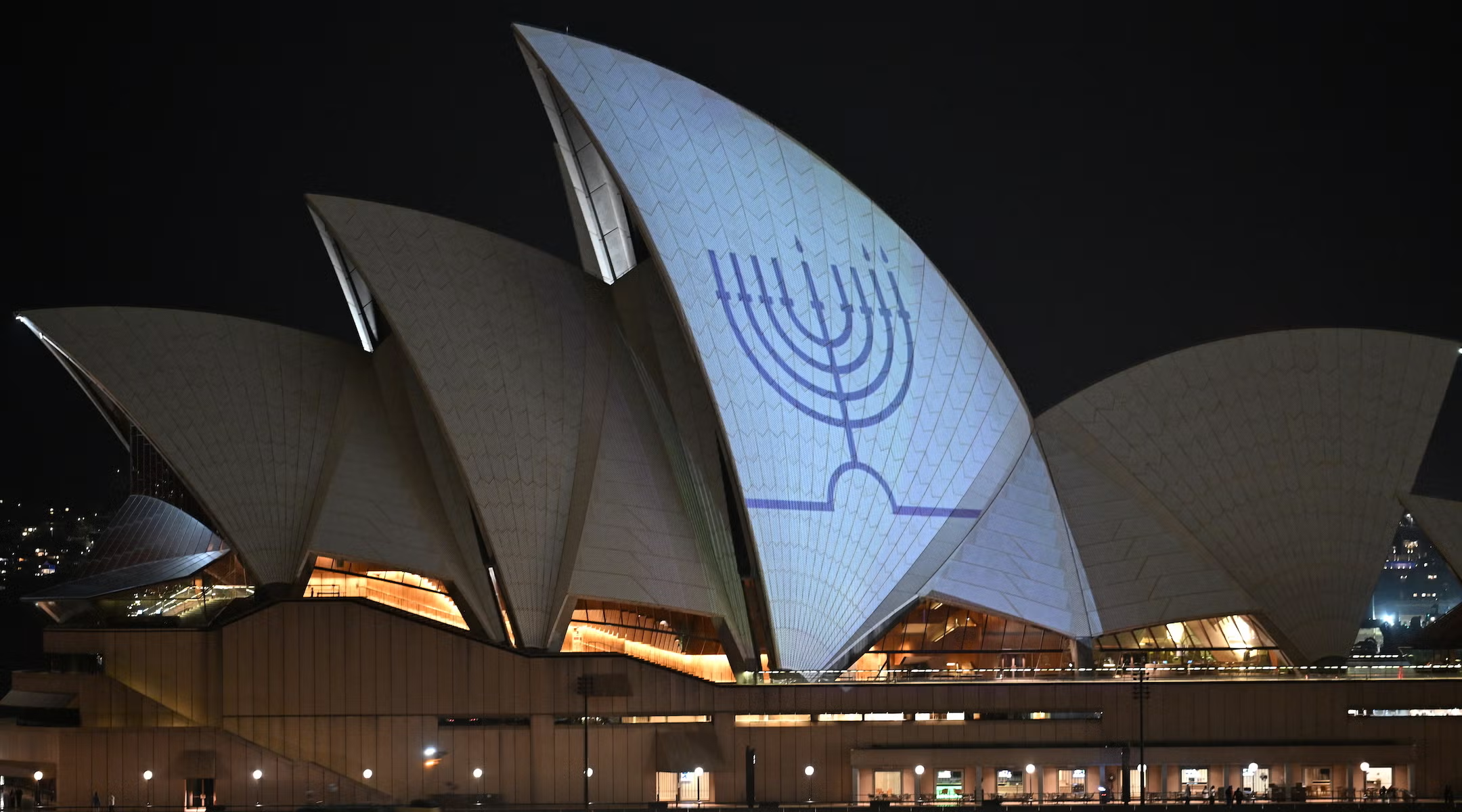
A warm summer evening at Sydney’s Bondi Beach should have been the kind of moment that lets a society exhale: families, friends, and a public Hanukkah celebration by the sea. Instead, it became a crime scene. Authorities described an antisemitic terror attack, one that targeted Jews not for what they had done, but for who they were. People were killed and injured while exercising the most basic freedom of a democratic society: to gather openly, without fear.¹
Bondi is not “over there.” It is not an isolated eruption of hatred that can be explained away as local pathology. It is a flare fired from a global trend line, one that shows antisemitism rising, normalizing, and then, too often, turning violent. Antisemitism does not stay rhetorical for long. When it fires bullets, everyone bleeds.
We have watched this escalation in real time. Jewish institutions across the United States have faced waves of bomb threats, harassment, and swatting incidents serious enough to trigger federal advisories.² Synagogues have been vandalized and firebombed, with cases investigated and prosecuted as bias-motivated crimes.³ Abroad, the pattern repeats with grim familiarity: synagogues attacked, Jewish schools targeted, and Jews assaulted in public spaces from Europe to Australia.⁴ The details differ. The logic does not.
The Jew is transformed from neighbor into abstraction, a proxy for conspiracy, resentment, or geopolitical grievance. That abstraction is the hinge on which violence turns.
Antisemitism is uniquely adaptive. On the far right, it dresses itself in “replacement” paranoia and blood-and-soil mythology. On the far left, it can masquerade as “justice,” while smuggling in the ancient claim that Jews are uniquely illegitimate and uniquely deserving of menace. In jihadist ideology, antisemitism fuses with apocalyptic narratives that frame Jews as cosmic enemies. The vocabulary shifts with the times; the target does not.
If anyone doubts that this is more than offensive speech, if they believe it is merely “online,” merely “political,” merely symbolic, Bondi is the rebuttal. A religious holiday gathering became a mass-casualty event.¹ Civil society does not fracture all at once. It erodes until violence feels, to someone, like the next logical step.
A healthy democracy requires robust free speech: the right to criticize governments, protest policies, and argue passionately in public. That includes criticism of Israel’s government, just as it includes criticism of any government. But free speech is not a permission slip to terrorize. Protest is not harassment. Advocacy is not intimidation. Political disagreement is not collective guilt.
When “Zionist” becomes a socially acceptable synonym for “Jew,” when Jewish students are told they do not belong, when threats and vandalism become background noise rather than emergencies, the line has already been crossed. And when that crossing becomes routine, violence follows.
Antisemitism is never only about Jews. It is a stress test for the entire civic order, for whether pluralism is real, whether minorities are protected, whether the rule of law is enforced evenly, and whether human dignity is more than a slogan.
Nearly twenty-five years after September 11, 2001, we should be honest about something uncomfortable: we are forgetting what hatred fuels.
Al-Qaeda’s ideology was not a generic outburst of anger at U.S. foreign policy. It was steeped in conspiracy thinking and explicit antisemitism. Osama bin Laden repeatedly framed the world as a struggle against “Jews and Crusaders,” casting Jews as puppet-masters controlling governments, finance, and media.⁵⁻⁶ This worldview was not incidental branding, it was central to how jihadist movements justified mass murder and recruited followers.
When we forget that, we make two dangerous mistakes. First, we flatten extremist ideology into something like “policy grievance,” which is not only incomplete but profoundly misleading. Second, we fail to see how antisemitic narratives continue to function as accelerants, simplifying complex realities into a single scapegoat and lowering the moral barriers to violence.
Global jihadist terrorism has not disappeared; it has adapted. Groups inspired by or descended from al-Qaeda and ISIS continue to operate across regions, often blending anti-Western rage with explicit antisemitism.⁶ When antisemitism is normalized in mainstream discourse, it does not stay there, it migrates, mutates, and hardens at the edges.
Bondi should force us to remember: antisemitism is not a relic. It is a live wire.
None of this requires abandoning Israel. I support Israel’s right to exist and defend its citizens from terrorism. But genuine support for Israel should strengthen, not weaken, our commitment to democratic integrity.
America’s electorate is not a playground for any foreign government. Not Russia. Not China. Not Iran. Not Israel. Not anyone.
Recent reporting about Israel-linked digital influence efforts aimed at American Christians and churches should trouble people across the political spectrum, including those who are strongly pro-Israel.⁷ Federal transparency regimes exist for a reason. “Legal” does not automatically mean “wise,” and shared interests do not justify foreign influence operations targeting America’s religious communities. A mature pro-Israel stance is compatible with a firm principle: U.S. policy must be decided by Americans, through open debate, without targeted manipulation by any foreign power.
What do we owe each other now?
We can honor the victims at Bondi, and the victims of antisemitic violence everywhere, by doing more than mourning. We can enforce the law consistently against threats, harassment, and violence targeting Jews, treating swatting, bomb threats, and arson as the serious crimes they are.² We can rebuild civic norms that make disagreement possible without dehumanization. We can teach the truth about antisemitism’s many disguises, right-wing, left-wing, and jihadist, and about how those ideas have shaped modern terror movements.⁵ We can insist on democratic sovereignty, rejecting foreign influence campaigns no matter whose flag is on the invoice.⁷
Because the real question Bondi puts to us is not whether antisemitism is getting worse. The question is whether we will keep letting it get easier, easier to say out loud, easier to excuse, easier to ignore, until it becomes easy, again, to kill.
History’s warning is clear. If we fail to remember 9/11, not just the images, but the ideology that drove it, then current or future generations will face their own version of it. Memory is not nostalgia. It is prevention.
References
- Reuters; AP News. Reports on Bondi Beach antisemitic attack, 2024.
- Federal Bureau of Investigation; Internet Crime Complaint Center. Public Advisories on Threats to Jewish Institutions. FBI; 2023–2024.
- CBS News. Synagogue Arson and Bias-Motivated Crime Investigations. CBS; 2023.
- The Guardian. Global Rise in Antisemitic Attacks. Guardian; 2023–2024.
- GovInfo. Osama bin Laden Statements and Ideological Writings. U.S. Government Publishing Office.
- Office of the Director of National Intelligence. Counterterrorism and Global Jihadist Threat Assessments. ODNI; 2023–2024.
- Arizona Public Media; The Times of Israel. Reporting on Israel-linked digital influence campaigns in the U.S.; 2024.
- Anti-Defamation League. Audit of Antisemitic Incidents 2023–2024. ADL; 2024.
- European Union Agency for Fundamental Rights. Experiences and Perceptions of Antisemitism. FRA; 2018; updates 2023–2024.
 Previous