
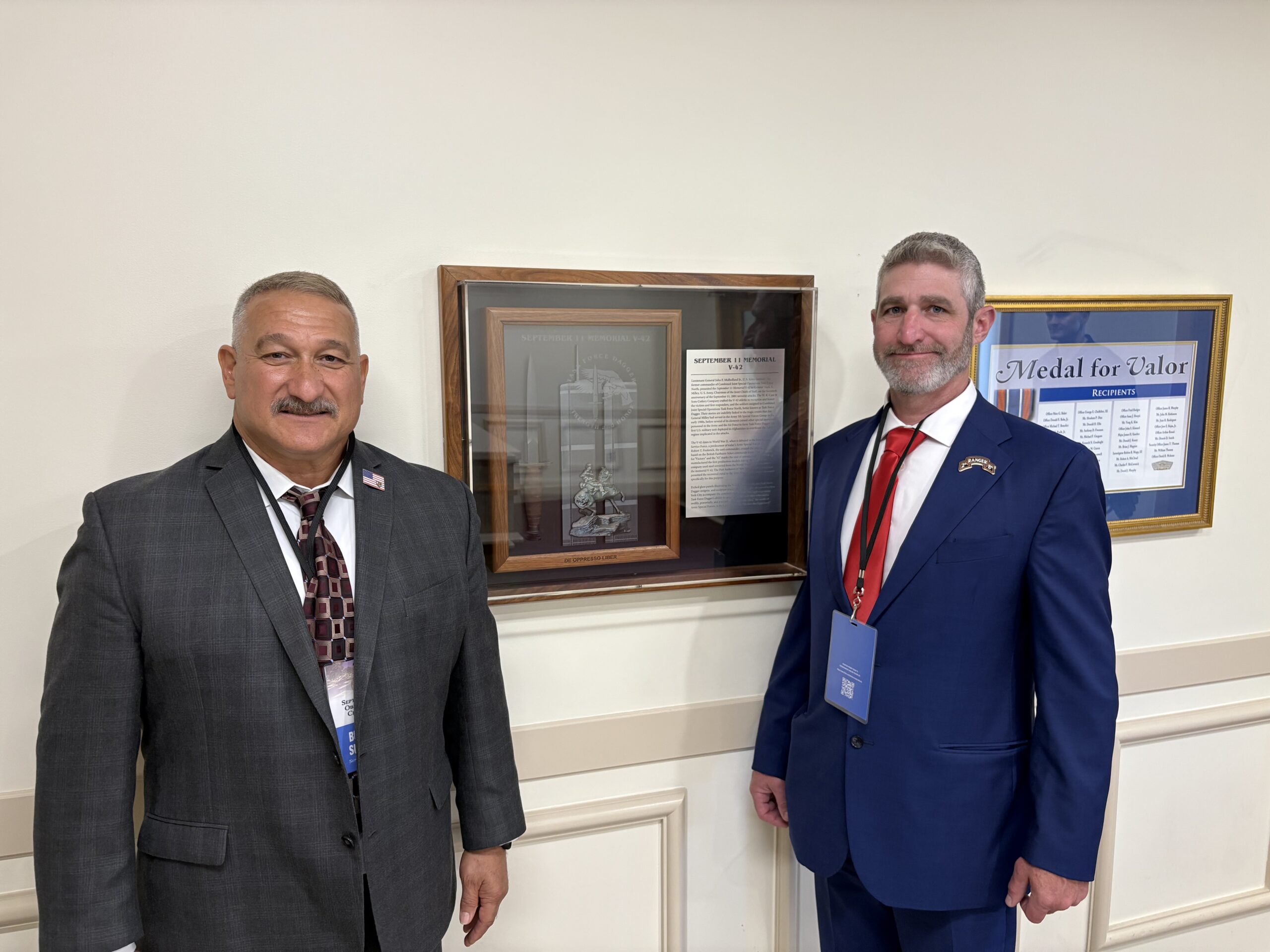
On September 11, 2001, Sergeant Chris Braman was working as an aide to the Chief of Staff of the Army at the Pentagon when American Airlines Flight 77 struck the building, propelling him into a harrowing 60-hour rescue and recovery mission during which he would save three lives, lead four people to safety, and recover 63 bodies from the burning wreckage, an experience that would earn him both the Soldier’s Medal for valor and the Purple Heart, while forever changing his understanding of service, sacrifice, and what it means to be called a hero.
This interview is part of an oral history project undertaken by Alex Bower-Leet in affiliation with the University of Kentucky.
I served 20 years in the military as an Airborne Ranger cook. I have multiple MOSs. My primary MOS was a ’94 Bravo that switched to a ’90. A 92 Golf that became since I was parachute qualified, I had a papa and then at the end I had a Sierra identifier on top of that was a special operations support identifier, which meant I attended many schools to obtain that MOS identifier which was allowed through SOCOM. I was prior to being stationed at the Pentagon. My first duty station was the Berlin Brigade in Berlin, Germany. As soon as the wall fallen, we became a rapid deployment unit. I was a 50-16 saw machine gunner during those times. I went to Iraq, Turkey, and Yugoslavia, to Macedonia, where we established the trade routes, to keep the trade routes open during the Bosnia-Herzegovina Civil War. And so we’d go from Macedonia all the way up through Bosnia-Herzegovina, past Serbia, Pristina, Albania, and to keep the people safe in those regions.
When I finished that deployment, I was offered to go anywhere in the world as far as being assigned. I jokingly asked, hey, can I go home? And I laughed. And I said, yeah, you can go anywhere. Where do you want to be stationed at? What school do you want to go to? And I said, I’d like to go home because I’d been deployed up until then my entire military career. And I got stationed at Fort Irwin, California for a short time working for the opposition force for the military. That’s when I went to sergeant school at Fort Lewis, Washington. While there, I was interviewed to become an Airborne Ranger with the 75th Ranger Regiment. Came back to the unit. They sent me to the Ranger and Doctrine Program, GRIP, at the time, now it’s called RASP. I passed all those courses, airborne school, and all the requirements to obtain the identifier as an airborne ranger. Got stationed at Fort Lewis, Washington with the 2nd Battalion, 75th Ranger Regiment. I ran the martial arts program there. I was also on a seesaw team, combat search and rescue team there. And then I was also a cook, as one of my primary MOSs.
We cross-trained as EMTs, we cross-trained for scuba school, boat operator, and many different things that we had used for mission requirements as an Army Ranger. The Ranger Regiment sent me to a general’s aid school at Fort Lee, Virginia. While at school there, I got selected to become the aide to the Chief of Staff of the Army, which is why I got stationed at the Pentagon itself. I got back to my unit, and it’s funny that, you know, my feet were elevated on the Sergeant Major in the First Sergeant’s desk, asking me why I was quitting the regiment, what’s going on, you know. And I said, well, it’s your fault, Sergeant Major, you sent me to an aide school and I got selected to go to the Pentagon. So I went to the Pentagon, got stationed as the chief, as the aide of the chief of staff of the Army there. We had many responsibilities there. One of them was that I became a purchasing agent, a procurement agent, for the chief of staff’s staff, which meant that anything they needed, I would obtain. So I actually learned how the supply routes in and out of the Pentagon itself through the tunnel systems, which helped me later on during the 9/11 attack at the Pentagon from the terrorists.
9/11 on that Tuesday was just like any normal day. It was a clear, beautiful, crisp, cold morning. Blue skies, got to work. I had come in. I just finished getting all the supplies that were needed for the day. They were having a prayer breakfast or something going on that morning with the general and the Secretary of the Army. During that time, I was inputting the information of the purchases that I had purchased during the morning and the night before. And my wife had given me a call. And at the time that she was doing that, I got some breakfast and I was eating as she was talking to me. And it was about 9:25 in the morning when she called me. And she called me frantically saying that there was a plane that hit the Trade Center. Oh my gosh, is everything okay? Are you okay? Your dad called me from Texas, wanted to know if Chris was okay. My wife was working as a medical transcriber at the time. So there was no outside television going on. My youngest was, my wife had turned on a video, a VeggieTales video, and my wife had turned on her computer to start working for the day. My other two children were already off to school at the time. Miranda is my youngest. Courtney, and then my oldest is Lauren, and they were in grade school at the time. My wife wanted to know if I was okay. I told her, I’m okay, I’m fine. And I did what everybody else was doing in the country where I typed up on the computer to CNN, trying to find out, hoping that I could get some type of information, because unless you have a television in front of you, which you don’t, at the Pentagon, because it’s an actual working building, it’s a headquarters for the military, so you don’t have time to watch TV.
So it’s a normal day when you see a one-star general or forward colonels running through the hallways frantically, because when you work for the four-star general of the Army that runs the services, it’s a normal occurrence. So you don’t pay any attention to the hustle and bustle of people moving quickly through the hallways. So I told my wife, I love you, I’m okay. And as soon as I hung up the phone, that’s when I was thrown. The impact came in, my window broke, we used to joke that, I’m moving on up in the Pentagon because I have a window, an office window, when the average person had a makeshift pretend window on their cubicle to make it look like they were looking outside, but it was just looking at a cubicle wall. And all I could see from the outside was it was the alleyway. So I knew if it rained, it snowed, if it was sunny. That was, other than that, you saw the other side of the building. But at that moment when I hit the cabinet, smoke and fumes started coming down the hallways. I gained composure. I started evacuating down the hallways, told everybody, get out, get out, get out. As we’d come down through the area heading towards the evacuation point, we had some people go off to the right side stairwell. I happened to go off House Fate pulls it. I went to the left, went down the stairwell.
As I came out, there was a DPS officer, defense police officer, struggling, carrying a lady and a baby. She had grabbed the baby from a gentleman that was walking with that child. And together, the officer and I and the woman ran another 60 yards away from the building where everybody was mustering, gathering up away from the building. The officer said, go get help, go get help. As I placed the baby down in the woman’s arms, the baby was silent, singed back her hair, of his hair, and was not making any noise, but appeared to be fine. I ran as fast as I could when I saw in the distance an ambulance and a police officer, a fire truck coming on to the Pentagon at the south, that was truck 61. That was the first to respond. They were on their way back from a fire call and got canceled and just happened to be heading back to the fire station house to end their call. And as they were pulling in, I ran amongst an aviation fire truck that was on fire. The aviation tower was on fire, and there was fire and debris all over the field in front of us, and that area was the aviation landing strip for the helicopters.
So I had no idea what had happened up until then. I ran as fast as I could to that paramedic that was getting out of the ambulance, and he was downloading his equipment. And I’m trying to breathe and yell at him at the same time, I need help, I need help. I have a lady and a baby. And he kept saying, more is coming, more is coming. And I was frustrated, yelling, I need help, I need help. I repeated myself. And what he meant that I figured out later on that he meant more medical personnel were coming. As he’s downloading the equipment, his eyes got really big as he looked over my shoulder. And behind me was the burning building. And there were three men struggling, carrying a woman that was burned from the back of her head to the back of her thighs. And as they came up, they placed the woman down. And I recognized it was a woman that I had turned my travel orders in. I went on temporary duty a week prior, and I had recognized who she was. And she was silent. Apparently, she was in shock from her injuries as they placed her down. I had accidentally put my hand on her, and said, it’ll be okay, it’ll be okay.
And I stood up and ended up returning with those three gentlemen that ran back towards the building. As we ran in between the burning fire truck and a 300ZX and a minivan that were on fire, they belonged to the employees of the aviation tower. The fire truck was burning. As we came up, I looked up and in the shadow of the window, I saw an image in the window. And it appeared to be like somebody was drinking a cup of coffee. Later on, I found out that was an imprint of somebody that was burned into his carbon imprint that was burned into the window when the plane had come in. As we ran into the fire area, there was a window as we came up to it and each of us hoisted each other up and grabbed. We’d grab one person after another. The fireman had a fire extinguisher behind me and had blown the fire extinguisher and he would yell, you know, Arlington fire, you know, come to my voice. So we started repeating, come to our voice, come to our voice. If you could hear us, come to our voice. Well, I couldn’t see anything. The smoke was so strong in there that I had to hunch down to my knees. And as I saw in the distance, it was just barely in the darkness with the movement.
Amongst the fire and the flames and the smoke that was blowing through, I just reached like I was following suit as the two others of us were doing. And I reached and there was a woman on her knees clapping. She was burned over 50 or 60% of her body. And she was clapping because she couldn’t, she couldn’t, her throat was burning. She couldn’t get a word out. I had ripped the bottom of my t-shirt from under my uniform off and dipped it in the water from the fire, from the fire, not extinguishers, but the water plugs in the ceiling were coming down, they were on the ground and there’s water everywhere on the ground as well as there was fire and oil and gas on top of it. As I reached through the cloud, we grabbed her and I pulled her out. We took her out of the building. I ran her to safety and my memory of her was her hands were stuck up in a mummified position. She was silent. I ran her to the medic as fast as I could. And as I looked over at her, you know, her face was covered in ash and she was burned. And she, I just remember the, you know, she wasn’t speaking, you know, and we ran her to safety as fast as I could.
And then we turned and ran back in and kept repeating this over and over again. And by the time I was able, we pulled out three people from the burning building, another person would appear and I’d grab that next person. We would just run it to safety, run him to safety. They would just appear and we’d just grab them and keep running to safety. All of a sudden they yelled, get back, get back. Another plane’s coming in. Well, it didn’t dawn on me until then. It was a plane that hit the building. It was just fire and ash and had every bit the sounds of combat. All I saw was fire and explosions. And there was a cage that was filled with propane canisters that were from the contractors that one was on fire. It was one that would explode and lift the cage up and come back down. And, you know, again, they yelled, get back, get back, you know, another plane’s coming in.
So all of a sudden, Lieutenant Colonel Ted Anderson and I and Jared and a few others that were with us, we ran trying to get back in the building, but we kept getting pushed away from the building itself to the right of the building. And all of a sudden, we were on the south parking side, and they were trying to push everybody across that had mustered those areas underneath the tunnel system that went underneath the 395 and the 110 freeways. All of a sudden, Colonel Anderson said, you know, screw this, let’s go. And I looked up and as I was doing that, I looked over and there was this Sergeant Major of the Army and there was Rumsfield and their aides running together away from the building, trying to get in for safety reasons. And as we turned, we ended up technically half mooning or half making a half moon in our direction and path and ended up getting pushed over to the 110 Fruey side where they were grabbing victims and making a makeshift medical area there for triage before they flew them out of there with the helicopters.
At that point, you know, Lieutenant Colonel Anderson got a hold of an FBI agent and said, We need to get back in there. We have to get back in there. We know where the people are at. We know we have to get back in there. They kept pushing us back. No, you can’t. No, you can’t. And all of a sudden, we were allowed to go forward. So we ended up getting pushed forward, trying to get back to where we were and ended up being pushed back away from the building again. And over that time, we ended up getting pushed back over the 110 free, which was adjacent or a parallel to the crash site, which was on the Arlington Cemetery side, just kept trying to push us over. And all of a sudden, they wouldn’t let us go back. And somebody had a cell phone that was able to get through. And amongst 100 people, we used a cell phone to communicate and call home. And to tell our loved ones that we were okay. And I just, I looked up and I just saw the building in front of us collapse in front of us. And I talked to my wife and I said, I love you. And I could hear my wife’s voice in the background and it was silent and she could hear the fear in her voice.
My wife, Samaria, was my high school sweetheart. And we had been married for many years until then. And I told her that I love you. I’m okay and I’m staying. And I could hear the voice in the background, a crackle. And I hung up the phone and gave it to somebody else. And then seconds became minutes, minutes became hours, and there were people in front of us that people would take charge, and then somebody else would outrank them. And so they would come again, somebody else would take charge. Try to organize a recovery team to go in to rescue people out of the burning building. And, you know, over time, they wouldn’t allow anybody back in the building. But we’d established a whole triage area and to set up to where we’d bring the injured or the deceased or somebody, anybody that we could get a hold of. And over time, we weren’t able to go back in the building. So it became closer to the late afternoon, almost nightfall. And all of a sudden, the building’s burning in front of us and the firemen are fighting in front of us back and forth. And then people started leaving and other medical personnel started showing up and setting up triage areas and all that stuff.
And I met this defense officer whose name was Lieutenant Colonel Mahi Edmondson, who was a nurse for the Defense Department. She worked in policy at the time. She said that she was going to be the officer in charge of the initial response recovery team. I told her what my background was and that I would get her whatever she needed. She said, okay, well, I’ll see you in the morning in a few hours. I will see you in a few hours too, because I have to meet with Arlington Fire, Police, and the other agencies to establish a plan to get back in the building. Because what had happened was we had, over the time, we had realized that it was no longer a rescue mission, that it was more of a recovery mission, that we’re recovering bodies instead of live personnel. She had left. I had sat down, I’d been going all day long, and I just literally sat down next to the triage litters that we had set up that were litters to carry the injured and the deceased personnel back and forth. I had sat down, next thing I know, I had ended up passing out or falling asleep. And people working around me thought that I was just sleeping, but I had passed out from the exhaustion of what I was doing during that day.
I woke up and realized the firemen were fighting, with hoses around me and I was drenched in water from the runoff, from the water, from the hoses. And I got up and I started getting with the fire personnel and went back away from the building and said that I’m here to help establish the initial response recovery team. And I’m the sergeant in charge of that team itself. I’m Sergeant Braman, and this is who I am. And they started giving me body bags. I’d get with the FBI forensic team, that supply team that gave us Nomax uniforms to put on to protect us, along with some masks, but all those masks were paint and dust respirators, just the basics of masks, but it would still protect us from the basic debris. At that moment, you know, it became early in the morning. I got a hold of a GP medium, which was a canvas tent that I had set up right there in the field, got a hold of a computer and a desk and stuff for Lieutenant Colonel Mahi Edmondson. And I got with the defense police officers down and in our supply area where I knew that I had a refrigeration truck that I could bring in supplies. But I used that for recovery of the bodies in a transportation of the bodies later on.
Like I said, working, lowering the tunnel systems of the Pentagon, I knew where everything was that I was able to use in my toolbox, so to speak, where I had to be able to use. Well, Amani Hemson, she came back and she was amazed that I was able to establish everything and set up everything by the time she came back. In the Ranger Battalion, part of our creed is we’ll never leave a fallen comrade and I will shoulder more than my share of the task. Well, that wasn’t just, you know, a creed. That was our way of life. So, you know, I immediately, I didn’t know any better, but to put things together in motion and establish, start establishing the recovery team. All of a sudden, we had General Jackson come over from Fort Myers. He said, my men are in charge and we’re going to come and recover and do all this stuff. And I said, no, sir. We have a team in place and I need to have personnel. If you could get supplies with personnel and leadership to run the program, I would appreciate it. So a captain and a sergeant major came over and we established every 12 hours, we’d switch out personnel for fresh legs to go back and forth in the building.
We got together with the firemen and figured out a way of going into the building while they were working on the fire and putting out the fire in one area. We were going in areas that were already exhausted, they exhausted the fire or that were not burned but were damaged by the impact of the plane coming in. So we established that we were going to go into the far right side. There was a door that was able to go through. And as we would go through the hallway, it was filled with ankle-deep water that was full of debris and human matter, twisted steel, and parts of the ceiling that were on the floor. And we were able to crawl around those. We carried a litter in trying to get through different areas to get there. As we got to a point, we had to clear debris away and were able to go down underneath some of the debris and we were able to start pursuing the recovery of the bodies. You know, there were areas where there were just pieces of human matter and pieces of bodies. There were other areas where people just looked like they were asleep, but they were dead from the impact.
There were times where, you know, I would end up with the FBI forensic team and they would make them, they were drawing up a map, you know, as we were picking up the bodies for identification purposes later for where that person was found. So whether they were just pieces of human pieces or saw completely intact bodies, we picked them up, placed them in a bag. I would write my initials on the inside and the initials on the outside, and I would call my team to carry the bodies out. You know, my rule was they died with honor, so they were leaving with honor. We had backed the refrigeration shop up to the corner, so nobody could see what we were doing except for so they could come out with honor. At the end of the doorway, it just seemed like walking from the darkness to the light, there were two, sometimes three chaplain at the end of the doorway as we were walking through the water, carrying the body, struggling, and our masks would come off and we’d take in some of the toxic smoke and then we’d put it back on. It felt like you were going through the gas chambers, is how much the chemicals hurt to breathe in.
The chaplain would give that person their last rites as they passed by them. It didn’t matter what denomination they were, what faith that they believed in, they were getting the last rites from God. And as they went into the refrigeration truck, that’s where Mahi Edmondson was, and a major there named Dan Patelio from the Marine Corps, and a doctor, and they would open the bag up they would verify that person was deceased and the doctor would pronounce that person deceased at that moment. And then zip the back up and then place them in an area to which another body would come up and do the same. And they would continue doing this over the next few hours. Next thing I know, it became Tuesday, became Wednesday, Wednesday became Thursday, Thursday became Friday. And we just continually went into these different areas, struggling through the debris as the firemen worked near us, pulling bodies out.
You know, as the teams changed over every 12 hours, there was a medical student named Eric Jones that pulled over to the side of the road, started giving medical aid to people. He was on his way to medical school at George Washington University. He was with me the whole time where we stayed and the other teams, everybody had switched out and got home and then came back another 12 hours. Eric and I continually stayed. And we would just sit on the edge, on the ledge, on the 110 side. And in our area, drinking Gatorade or water that we got from the Red Cross that established a little command post there that every time my men would come out, are you okay? Would you like to talk? Would you like to… They were worried about our mental capacity if we were okay. They were worried about, you know, if we had something to eat or food or water. And I said, no, ma’am, I’m okay, but can you talk to so-and-so? And I would give him some of my military personnel that were working that were civilian.
There was a young man that was trying to get back in. He was looking for his wife. He kept going back and forth over the next few days, trying to get in, trying to find his wife. And, you know, his wife was deceased, but at the time we didn’t know who he was or what, you know, where his wife was, but he was determined to find her. I vividly remember him. And we’d tell him, no, sir, we haven’t seen her yet. We haven’t seen her yet. You know, not knowing what his wife looked like or who she was. He just said she worked in this, you know, in General Maude’s office or he worked in the finance department, where those are the areas that were completely destroyed. And along with the Navy command center, was completely destroyed. As we continued going back and forth, pulling bodies, and the next shift would change out, Eric and I would just sit and just kind of chuckle and laugh, and just talk. And it was just, to keep our mind going in between the time we’d go through.
All of a sudden, the fireman said, we can’t get back in. We have to shore up another area in order for you to recover personnel. Well, at that moment, that was Thursday morning. And it was kind of odd. Danny Pitelio, who was our Marine Corps major, noticed a Marine flag up on the fourth floor of the Pentagon from the debris where the building was split in half and had fallen down below. It was way up in the corner. He just noticed the red flag. Well, that turned out to be the commandant’s lawyer’s office. And he had barely escaped out down the hallway himself, down through the stairwell as the fire was going. He and his personnel barely made it out alive. And, you know, it became our mission to try to get that flag. Well, Danny got Major Pedelio, Danny, got with the fire chief and was able to go up in a boom from the fireside, fire, from fire services. And he was able to grab that Marine flag as he came down. He brought it down and Eric and I and Danny, we all hugged each other. And there was a moment of just emotion because it was a great moment because it was a moment of defiance. It was a service flag. It didn’t matter what service it belonged to. It just happened to belong to the Marine Corps. And we gave each other a hug. And then we turned around and Lieutenant Jared was with him. He was from the Marine Corps. And as we walked away from the crowds, underneath the 110 freeway over, we were returning that flag up to the Navy annex where the Marine Corps had set up a command post in that area, up at the top.
Well, the Marine general was up there along with that lawyer that the officer came from. As we walked up the hill, we looked over, Arlington Cemetery was behind us, and it seemed like there were a million reporters in front of us. All we just saw was cameras everywhere and stuff, and we didn’t want to talk to any of those people. We just wanted to walk up. Lieutenant Gerard went over and talked to, he was in communications with the Marine Corps, and that we were returning that flag up to that general. That was up at the top of the Marine annex. And as we walked up the hill, we came up and, with the Marine flag, there’s four of us, Major Petelio in the center holding the flag, myself, Eric Jones, and Lieutenant Jared from the Marine Corps on that side. He ran over and started talking to the media at that moment. As we walked up the hill and met the general, and that lawyer up at the top and the general shook our hands and said, good job, good job. Oh my gosh, you know, thank you for bringing our, returning our colors to us.
I didn’t realize the significance of that until later. Each of us shook the general’s hands and I looked over and I shook the general’s hands and out of my, out of the sleeve of my Nomax fire uniform that I was wearing, water came out. And what that was, pure pure sweat from wearing that uniform that I’d never taken off. And I shook his hand and in a moment of humility and embarrassment as I shook his hands, he just looked over and smiled at me and just said, good job, son, good job. And gave us all hugs. And then we turned around and walked downhill, back down the hill to the Pentagon, trying to go back to work. As we got back in, I didn’t realize that we had worked so much and I was so focused on the mission that they had put a fence around and built a city around the, a working city, I call it, where the different agencies had their command posts around us. And to get back in, to get back in through that, through the fencing area, we went back, we tried to get back to work.
And at that moment, they said, Sergeant Bramen, you’re being relieved of duty. And I said, what are you talking about? I need to, I have to go, I have to continue working. What are you talking about? They said, you’re good. You need to go home. You need to get, you need to leave. Well, during that time, I had run into this, I’d seen the Sergeant Major of the Army and his staff, and he couldn’t believe that I was still there. He had no, he goes, Sergeant Baemen, you’re still, you’re still working. Oh my gosh. And what’s it called? We just continued, continued the mission. Well, at that moment, I was being relieved to go home. All I had was the clothing on my back that I had from Tuesday on the 11th that I was still wearing underneath the Nomax uniform. I got a trash bag from the Red Cross and they’d give him some clothes to put on which were, I’m a big guy, so it was kind of, they were extra large and I needed double legs. So they were a little too small for me, but they worked. I put everything into a trash bag and left with Eric. Eric and I were going off and he went off to look for his car because his car got towed and so did mine. It got moved away because they were parked in the south parking lot, put into a separate area.
Eric, I gave him a hug and he went off. And as I’m walking, looking for my car, I noticed that there was an area that they established for families to come and to seek questions for their loved ones that were in the building. They had a food area and all that stuff. And I looked up and my eyes became fixated on this little girl and this mother that they were talking to the chaplain and talking and stuff. And I looked over and I just kept staring at her and kept staring at her. And I couldn’t leave, my eyes couldn’t leave the gaze of just staring at this little girl and this mother that were frantic and she was trying to seek questions about their loved ones. I finally found my car that was put away in a different area, you know, towed to an area. I couldn’t believe I had the keys still in my pocket to my car because I put them in there that Tuesday morning and went to work. I got in my car and I started driving home and it was the weirdest feeling being on a freeway that’s normally packed with vehicles to just to drive home, just with normal gridlock, and there was nobody on the freeway.
I drove all the way down to Springfield, Virginia, where I lived in Kingstown, which was Alexandria, Virginia. It was where I lived at the time. And I got home, and my wife was waiting for me at the door. I got out of the car, and she ran over and gave me a hug, and she held me like she had never held me before. Just squeezed the air out of me, she was that scared that I wasn’t alive because family members had called from California where we were from and from all over the area asking, where’s Chris? Is he okay? Is he okay? And she would say, I don’t know, but I know he’s still there. And he had talked to me once and that was, you know, that was Tuesday afternoon and to say that he was okay. My wife followed me upstairs. I left my bag of clothes in the trash bag outside because they were full of human debris and human matter and they reeked of smoke and fumes.
As I went upstairs, my wife, my kids were asleep and my wife had followed me into the bathroom and sat on the commode as I took a shower. As I was taking a shower and wiping off all the soot and there were areas of my face that I hadn’t realized and in my hands, that I hadn’t realized that I had first and second degree burns on my face that just felt like a really bad sunburn. As I just pulled away the skin, like it was just dry skin, it was actually burned areas on my face, on my forehead. And then I didn’t realize that I was breathing in 1700 degree weather, which was what the fireman had told me, how hot it got in there. And it just felt like a really bad sunburn that was just, did hurt really bad, but it just, I didn’t pay any attention to that. My wife was talking to me and just sat there silent and they would talk to me as I was rinsing away just the brown soot and fire debris that was coming off my skin. I then dried off, got out of the shower, and went and laid in our bed. She laid next to me, holding me, you know, just squeezing me so tight that while she slept, while she laid next to me. Well, I never fell asleep. I looked over in the corner, the corner of the darkness of my room, and I still saw the Pentagon burning and the screams going on as I just laid there quietly. And it’s as if I’d never left the Pentagon itself.
You know, I told her, I gotta go, I gotta go. After a few hours of laying there, I just, I gotta go. I gotta go back, I gotta go back. And she didn’t want me to leave, but she knew that, you know, I kissed, that I had to go. I kissed my children goodbye. And I went back, drove back to, as I’m driving back on the freeway, there was still nobody on the freeway. And all of a sudden I had the radio on. I don’t know how it was just on and just happened to be Lee Greenwood which started, I’m proud to be an American. and I was listening to a song and I just remember kissing my children, and I remembered that little girl, that blonde little girl that I just came fixated on. And I just looked over and I would see her and I’m driving. And all of a sudden, I just slowed down and pulled over to the side of the road. It was about the Shirlington exit, which was the exit before, which is Glebe Road, Shirlington, right before the Pentagon. And I just became emotional, started crying and just started thinking of this little girl that I could not tell her that her mother or father was not coming home. That I could not tell him that I couldn’t save him to bring him out, to bring him to safety. I had no idea what it was, how to explain to her that I could not bring her loved one home. I gained my composure, started driving again, got back to work, and parked my car, you know, in the Pentagon Mall across the way, across the 395 freeway, because that was the only way to get into the area.
And I walked underneath the tunnel system to get back over, tried to get into the into there. And they had put a fence up and they had a they wouldn’t let anybody in. And they just said, That’s Sergeant Braman. Let him in. You don’t know who that is? That’s Sergeant Braman. He’s in charge of the recovery team. And at that moment, I went back to the building. I went back into the area where the firemen were fighting in front of us. And you had the FBI command center. You had the police area, you had the command area, you had the fire chief command area. And then you had our command. Our recovery area would like next to the next to the Red Cross. And they just said, Sergeant Braman, you’re not going back in. You’re not you’re not going back in and I need you to go see to go home or go to the medics to get looked at. You know, go seek medical personal treatment. And I didn’t know what to do at that moment. I just said, okay, fine.
So I went back in the south parking entrance of the Pentagon, which was away from the burning area and away from the area that the medical personnel were going back and forth, which was a no longer a rescue, it was recovery and they were still shoring up the areas in order to go back in to recover more bodies. I got into the area, I reported, I went back into a different area to where the Secretary of the Army had set up his office and the General of the Army and everybody had stepped in a different area corridor of the Pentagon. As I went up and I’m walking through the hallway and it just seemed like I was floating. I was just walking really slow, carrying the trash bag with all my clothing in it, some that I had worn in the last three days for the last 60 hours. And I was walking through and next, I ran into somebody that was in my section and then I ran into somebody else and they’re like, giving me hugs. And I just had this thousand-mile stare is what they told me. I just kept looking off in the distance and just kept, just slowly, talking to them and was coughing because it was kind of hard to breathe. My lungs were heavy, not realizing that they were, it was labored because of the amount of chemical toxins that I had breathed in for the last 60 hours.
And I ended up going to the Sergeant Major of the Army’s office and I talked to him and he gave me a hug and said, Sergeant Braman, I cannot believe that you stayed so long and you continued on the, you know, the work, you know, the work of a leader, the work of an NCO, the work of a sergeant. You know, I’m talking to the highest ranking sergeant in the Army, which was the Sergeant Major of the Army. He gave me a hug, gave me a coin. it was just his nature. He gave me a coin and it was his personal thank you. And he’d given me one when I had gone, when I had worked, when I first got there and said, this coin will never tarnish if you stay an outstanding NCO and you do what the the backbone of the military, which is, that’s the motto of the, as a sergeant of of the army. You’re the backbone. You’re the strike force of them., I said, sir, I need to find a place where I can turn my clothing in because they’re full of biological matter, bio matter. And he said, go down to the Delorenzo Clinic, which was on the other side of the Pentagon from the Joint Chief of Staff in the defense side of the building. So I was taken downstairs and I was standing in line to be seen. And I got up to the front and I said, I need somewhere to return my clothing in. They’re full of biological matter. And they were amazed. They had no idea what, you know, like, okay, well, here, sign this paperwork. I’d signed paperwork saying I was exposed to biological matter, biochemicals and everything else.
And I tried to turn and go, and in the distance, I heard this little voice, and it was Lieutenant Colonel Mahi Edmondson who was there to be seen. She had sprained her ankle, and she was also being seen by the medical personnel. And she said, Sergeant Braman needs to be seen right now. And I just said, ma’am, I’m fine. I just want to go home. I just want to be with my family. And she said, you’re going to be seen first, Sergeant Braman. And so I was pushed to the front of the line and seeing, I was immediately, they x-rayed my lungs and a doctor looked at me and thank God that they did that because at that moment, it was the military acknowledging that I was exposed to biological chemicals and biological matter, which later on became an important factor in my treatment for medical care. I got pushed into an area where they had a psychologist back there and they’re meeting in a room with some personnel and they were talking about, in a circle, kind of like a support group almost.
Well, when it came my turn to speak, they didn’t know that I was in the fire and that I was in, kept going back and forth and rescuing and recovering people. And they had no idea what I had done. And I just looked up and I just said, because they were on the other side of the building to where they were working a normal day, working as the building was on fire, because the building is so massive that they were able to continue their job as if nothing else was going on. And running the military while the other half of the building was on fire. And they had realized, the psychologist realized that I was a first responder, that I wasn’t like these people that were sitting next to me. And they pulled me aside and said, sorry, Braman, we need to talk to you, right? You know, sorry, talk to me and said, here’s my card and you need to talk to me. And they said, sir, I just want to go home. I go, fine, I’ll talk to you, but I just want to go home. And I got, and I was released from the medical services and given some silverdene to put on my face, which is a burn cream, right? And I was told, you need to report back to the hospital when you get home that I need you to report to the hospital. And I said, fine, I’ll do that. I agreed to do that.
I went home, you know, and this was all Friday. And all of a sudden, I get a phone call from the Secretary of the Army’s office saying that there was a woman that recognized you from a photo it was from the newspaper. It was the picture of the Marine Corps flag, four guys coming out of the Pentagon with the Marine flag. It was on the front page of the Washington Post and the Washington Times. And she said that was the man that saved my life. That was the man that saved my life. And she kept repeating that. And they sent a car to come pick me up from the Army and drive me to Walter Reed. And as I was waiting there outside the hospital room at Walter Reed, this woman was being tended to for her burns and re-wrapped I was just sitting there, just remembering, and kept seeing the Pentagon, the burning building, and everything that we had done for the last few days. All of a sudden, I was told to go into the room. I waited about an hour for her to be wrapped and prepared. She looked over and said, it’s you, it’s you, it’s you. You’re the man that saved my life. I didn’t know how to take that. I just looked at her, smiled, and gave her a hug as best I could because she was burned over 60% of her body. My memory of her was she was the woman that I remembered, one of the first women that I pulled from the building that was in a burn in the mummy position. And I just kept remembering seeing her in silence. And then I’m seeing her now and she’s talking to me.
She had her husband on the phone and he kept saying, thank you for saving my wife. Sheila kept saying, thank you for saving Sheila. Thank you for saving my wife. You know, God bless you. God bless you. Thank you for saving her. I gave her a hug. I told her the story of everything that I had done and that I have to get back to work. I have to go, I have to go. And I left the hospital and went back home and then tried to go back to work the next day at the Pentagon. And they said, sorry, Braman, you need to go home or go to the hospital, one or the other. And I went home and after I was tended to my injuries, I just was with my wife and my children for the next, for the remainder of the time. And then would go back to work at the Pentagon and then they would send me back home. And I just kept trying to go back because in my mind that I didn’t do enough. I had to keep going. Because as you remember, under our creed is you never leave a fallen comrade.
I just kept trying to go back and they kept releasing me to go back home and I ended up staying home. And over the course of the time, they told me that I had rescued three people. I led four to safety and there were 63 body bags that I recovered with my name and my initials on 63 body bags. You know, I was told that we were going to receive some medals for what we had done. I told him I didn’t want any medals. I didn’t want any medals. What I did was because that’s what I was the right thing to do. And see, I prayed to go back in the building and I said, dear Lord, give me the strength I’m about to do. And then I was told what I did. I was so jacked on a gentleman over the 60 hours that I was there that I just kept going, like the Energizer Bunny, just kept going and going and going. And not realizing that I had lost 17 pounds in body weight from the amount of sweat that I had while wearing that Nomax uniform and my uniform underneath. And every time I’d pull this, the fire boots off, water would just come out. It was just pure sweat. And I did not realize that until later. The sides of my hair were stricken white. And I was told by the doctors later on that was because the amount of stress that I put my that I’d put my body through. And the day that I was taken to the hospital, I didn’t know why I was going to the hospital, why I was going there. See, for the other people had died from their injuries, that I had rescued and ran to safety.
You know, on the day that I received the medals, I’m sitting there in a full dress uniform, and I rarely put the uniform on. I was the first guy in the row because my name started with a B for Bremen. Cruz was sitting next to me, this young specialist who was in the building that had rescued somebody, tried to help, got her office out. You know, I’m still sitting there and I’m hunched over. Everybody’s seeing a position of attention and I’m leaning forward eating a Ziploc baggie full of Tums medicine for the acid reflux that I had, that from all the chemical toxins that I had digested, that I just, it just kept burning and it just, it felt some comfort just eating the Tums. As I looked up, there were hundreds of people sitting in front of me. I thought it was hallucinating because as I looked up, I saw stars on the ceiling. It looked like the Milky Way. What it was was there were so many generals and admirals sitting in front of me that the light was shining on their lapel. It was reflecting off the ceiling. And it just looked like the Milky Way in front of me. I looked in the crowd and I saw my wife and I saw my, he hated me calling him my boss. He was the OAA Secretary of the Army, the Assistant Secretary of JB Hudson, an incredible man that had lost and had been to so many funerals since 9/11.
Because this is November now, when we’re receiving the awards at Fort Myers. And as I looked up, he just looked so saddened in grief. You know, he was, JB Hudson was in Florida at the time of the attack, visiting his daughter, because his daughter, he was there for his grandbaby, just being born. He immediately came home and here he is sitting in front of me. And I just noticed him next to all the generals and admirals sitting next to him, along with Miss Riley, who was his assistant, his assistant to the Secretary of the Army.
We were called to a position of attention. I looked up and I saw, you know, General Keane, the Vice Chief of Staff in the Army, along with the Chief of Staff of the Army, the President, and along with the Sergeant Major of the Army at the time. They put the medal on me, looked at me, and shook my hand, and gave me a coin. And then the Sergeant Major looked up and said, Sergeant Braman, I’m so proud of you. You are the backbone of our beliefs. You are the backbone. You’re an outstanding NCO. And I looked over as he went to the specialist crews that was next to me and I looked over at him and I said, Sergeant Major, as he gave me another coin, I said, Sergeant Major, I already have a coin and mine is never tarnished. See, as he looked at me as he went to the next one and the next one. And that gaze, because he doesn’t, our leaders don’t realize that your subordinates that you lead remember everything that you tell us because you are a leader. We look to you for guidance. And he just smiled. And he went to the next one and the next one as they pin the soldier’s medal for valor and for heroism and the purple heart for the next injured. and the next. I was one of a small few that received the Purple Heart and the Soldier’s Medal. I received the Soldier’s Medal for valor and heroism as they read the description of my medal. I still didn’t understand the meaning of being called a hero.
To this day, I still don’t consider myself a hero. I just consider myself a soldier going after his fellow soldier and man and woman to bring them out to safety. It’s really strange to know that, you know, when you’re labeled that, you’re forever labeled that. I don’t know how to this day. Here we are going to be 25 years later. When Sheila Moody, It was one of the ladies that I rescued when she introduced me as this is the man that saved my life. And I just looked at him and said, we’re friends in Christ. We are friends in our faith and friends for life. You know, people think that they owe you a living because you saved their lives. You don’t owe them anything or they don’t owe you anything just to live the best life that they can. There was a movie, Sergeant York, where he comes back. He received the Medal of Honor, you know, for what he did in World War I and all the stuff, all the people that he saved. And he said that they gave me this medal for things that I did over there. He says, well, a lot of people didn’t come back. And that’s exactly how I felt when I saw that movie. I could understand what he meant, but a lot of people didn’t come back. And they gave me a medal for doing what I felt was the right thing to do. When there were thousands of people running the other way, something in me just had me run in the direction of fire. I don’t know if it was my belief system. It was God. It was, I tell everybody, it was God that directed me and the military that trained me. And that’s as we discussed earlier when I told you that patriotism is not something that washes off in the shower. It’s something that you’re raised with, something that you’re born with, and something that you believe and you believe with.
And it’s an honor they have me speaking all over the country now as a spokesperson on terrorism awareness. And I tell people all the time that it is a wonderful honor to speak to the American people, for you to take time off of your busy day to come and hear me speak because I’m part of history. I just think it’s an honor for you just to speak in front of you and to come and to come to hear me speak and talk just to tell a soldier story. You know, my order number from my Purple Heart, it all comes in sequential order. And I just happen to be 29011, 2911. And it just happened to be one of the first, apparently in history, to receive the Purple Heart and the Medal of Valor, the Soldier’s Medal, on U.S. soil because Hawaii was a territory and not a state at the time. And because my name started with the letter B, I have the honor of being not the first, but one of the first to receive it and the importance of it. And if you go to the Pentagon Memorial in the Pentagon Chapel itself, what people don’t realize is that memorial in the chapel where people can go and reflect and desire their faith, it’s a non-denominational chapel. The Vatican had helped sponsor those stained glass windows that are inside there that represent each of the sections and the airplane that hit the building, 77. And each of those, each piece on there was laid by either a family member or a survivor. And we’re given a token, a piece of that glass to, as remembrance, of laying that glass before it was fired and laid in the chapel to represent the family members and those that died and those of the survivors of us.
So when you visit the chapel at the Pentagon on a Pentagon tour, please know that you’re not just seeing a stained glass window, you’re seeing a piece of the family and a representation of those that have passed and those that have survived. And next to it is a memorial with everybody’s name that had passed at the Pentagon. And that please sign the, there’s a ledger there that you can sign. And it’s saying that you visited, the families appreciate you being there, and that you’re remembering their loved ones. For me, every time I visit, to me it’s a graveyard. To me, there’s ghosts. When I come to visit, I have hairs that stand up on the back of my neck because in my remembrance there was fire, smoke, debris, and the screams of people just trying to survive. And to me, that’s every bit of the sounds of combat.
And I really appreciate you allowing me to tell my story. I apologize. I got a little emotional as I’m talking. As I’m drying the tears away from my face as I’m talking to you, know, you only see the soldier with the shiny medals, but know that there’s a story behind each of those medals that are on his chest and that he lives that, he or she lives that memory of that conflict that he’s been in. And PTSD is real. And second post-hand PTSD is real as well is where the loved ones or the survivors that are dealing with that person that was going through those injuries and that helped them get back to being healthy again. I had chemical pneumonia with radian heat burns were my injuries, and I ended up with lifelong asthma issues for the rest of my life that I deal with to this day. I take 13 different medications for the rest of my life. You look at me and I look healthy, but that’s because God directs my path. And I am a soldier, and I’ve had the honor of doing many many things since 9/11. One of them was carrying the Olympic torch. There’s a famous picture of a soldier in an Olympic outfit running amongst 183 flags to represent those that had died. We see there were 190, and we don’t count the terrorists. We only count the true Americans that died with honor on that day.
Well, just know that there’s more to a story than just the shiny accolades of a soldier. You know, that’s why PTSD is so real. You know, and people ask me, so what do you know, how do you feel about stuff? You know, I’m able to go across the country and speak and whether, whatever their beliefs are, whether they’re racist, they’re not racist, they’re, you know, I found that there’s reverse racism, you know, and it’s real. There’s also while I’m there, their feeling of being an American takes over that personal belief of racism. So they behave while I’m in town. And that one moment while I’m there, the moment of humanity, they asked me, were you colorblind, Sergeant Bramen? And I say, in my heart, I am. I had the ability to look at a human body. And we’re all identical. We all bleed the same. We’re all made-up the same. We’re human. And they don’t know. They just kind of look at me and take that, like, look within themselves and take that deeper thought of like, am I doing the right way of the way I’m perceiving life? It’s really crazy.
And it’s strange to me because I went from a job where I never talked about anything before I got stationed at the Pentagon to only talking about 9/11. That’s all I’m able to talk about, even though people want to pry into the special operations world because it’s such a secret. And it’s there for a reason, because you cannot have the cameras and somebody telling you and second guessing you when you’re at the end of a rifle and you’re put in and you’re put in harm’s way. There’s nothing that, I, over the years, people, there’s been so many different agencies have tried to get sound bites out of me to, quote, oh, Sarban said this. Oh, he said that, you know, like it’s gospel, you know, like when I was on the Oprah Winfrey show. It’s crazy, you know, I didn’t even know why I was being brought out there, right? But it was national. It was that November, right after getting my medals. It was national Thanksgiving week for her. And she surprised me with Sheila Moody on stage, kept telling me that, you know, her injury, she couldn’t be here and all that stuff. And then she surprised me on stage with Sheila being there.
And as a rescue and a, somebody was rescued by somebody. And Miss Winfrey didn’t understand that she was no longer the most important person in that room to me. And all I wanted to do was be with Sheila, because the last time I saw her, she was in the hospital. And she kept, when I sat down next to Sheila after, in between the break, she kept saying, Right, Sergeant Braman? Right, Sergeant Braman? And I’d look over. Oh, yes, ma’am. Yes, ma’am. And then go back to being with Sheila, because Sheila was the most important person there to me. I don’t know if that makes any sense.
Me and Sheila are both grandparents. We’re both grandparents now. I just saw her last year., I did an interview with National Geo. I’ve done 5 documentaries with National Geographic. People have no idea. They look at one thing and have no idea what the bigger picture is. All the heartache that I’ve gone through to get my lungs back just to live. The surgeries I had to go through. I went through spine surgeries. My first spine surgery was in 2005 because that’s how long it took, almost five years to get my lungs under control at Walter Reed going every day with NIH, performing experiments on me and trying to figure out how to get my lungs to survive. Because there’s a lot of people that have already died from 9/11 as the recovery workers and the rescuers and all that stuff. You know, and most people don’t realize that, you know, and why we have parades and why we acknowledge the past, you know, because it also helps with the recovery by having that parade, by having that acknowledgement to that person that that could be 80 years old, 100 years old, that helps him with his peak, his frame of mind, his PTSD or she, it’s that’s that’s the importance of the historian telling the story of of the soldiers has come home for war.
And all the other stuff, God made me to be a soldier, but the greatest thing I ever did was become a dad. I speak on terrorism awareness. I also speak on emergency management. I speak on leadership in a high stress value area environment. I speak on, I mean, so I have a huge platform that I’m always doing something, right? So, and I make jokes. I go, you know, I’m not even, people ask me all the time, do you have a publicist? How do you get out there and speak and how do you do all this stuff? I go, I don’t know. I go, it’s God’s will. I go, because the day I received the medals, I knelt down and prayed. My father would give me a book to read prior to that day. And it was the prayer of Jabez. It was a little small little prayer in the Bible. It’s a little thing you’ll miss right over because it’s only a sentence. You know, it goes all the way through. And it says, Jabez asked God to expand his territory, not in the direction that he wants to go, but the direction that God wants to take him in. And the Bible says it was manyfold that God had blessed him with, because he had asked God to direct his path, put him where you want him, put him wherever you need him. This is what I’m going to do for you. And the day I knelt down and said that, the day I received the medals, I don’t know why I’m out there still speaking. I have no idea other than it’s God’s will. And I tell everybody, 9/11 was about all of us collectively, not just one individual. And I tell people all the time, it wasn’t just me that rescued you. It was this person, this person too. It was just my hand that you grabbed. And it was just me that ran you to safety, but it was all of us collectively that did it.
So it’s just, it’s really crazy, right? So I’m just like, and the last documentary that I just, that I just finished, it actually aired this year. And it’s made by a producer named Michael Gier.
So what do you think 9/11 is about all of us? That’s what I was telling you early. 9/11 is about all of us collectively. So there’s no such thing as, oh, well, I wasn’t here, I was there, but I lived there. No, you experienced being there. You experienced the fear. You experienced patriotism right after 9/11 when all the flags went up. You experienced, everyone can tell you, just like everybody can remember who was alive during that time, where JFK, when he was shot. Okay, this is your part in history that you can remember. This country needs to go back to caring about the person next to you and not necessarily me, what about me and what can I get for me? You know, it needs to go back to, you know, caring about the fellow man, for all mankind is what we were before 9/11.
Because everybody after 9/11 turned into something else, they started hate mongering and I have friends from all different faiths. And the thing is, what people don’t understand is, you don’t hate the person next to you because he’s of a different race, color, or faith, because they’re just trying to live a life like you are. They’re just trying to go through life and raise their children and be part of something bigger than themselves. Right? And you’re misunderstanding that you think that they, that they’re after you or they’re going to, they’re trying to hurt you. They’re not trying to hurt you. They’re just trying to live their life. Now, there are a few zealots out there, but that’s in every faith. Right now, unfortunately, in the last 25 years, you know, people don’t realize that the war on jihad has gone on a lot longer than just these 25 years that have just passed. The war, the holy war has been going on for many, many years. And that’s why, for thousands of years, but that’s why our country went after the money side of it to track the money where it started. And people don’t realize, you know, if you do your history, the money aspect goes back to pre-1920s during the stock market, where the two brothers were putting money away in the stock market to raise money for the war jihad over this overseas, So, and people don’t understand that, that that’s why we had to go after the money and have to find where everything first first established and where everything was going to be, the problems that everything is at.
So as far as 25, here we are, as you said, 1/4 of a century, 25 years, we just can’t forget. We can never forget. We can forgive, but never forget. And never forgetting means making sure that all of us are educated, to educate ourselves, because the more educated we are, the less fearful we are. So in that way, we’re doing that. I noticed in Northern Virginia, when I lived there, was a one type of class of person. It was educated, because that’s where the majority of the people would go if they were, when they get their higher degrees. It was joke, they go to run the world there. Well, no. You look across the way, it didn’t matter if they’re Pakistani, if they were from India, if they were, English, German, stuff. They worked for the State Department, they worked for NSA, CIA, they worked for any of the agencies, you know, at a different level, right? And most people don’t understand that, you know, that that’s, in that, how everybody would treat each other as they treated everybody with respect and that I respected your opinion, you respected mine. We didn’t throw blows at each other because that’s where the ignorance comes in. You know, that’s why I said we have to educate ourselves and me having the ability to go across the country and talk to children, show them that, look, I was directly impacted, directly injured, and I have no hatred for my fellow man. And you shouldn’t either.

 Previous