
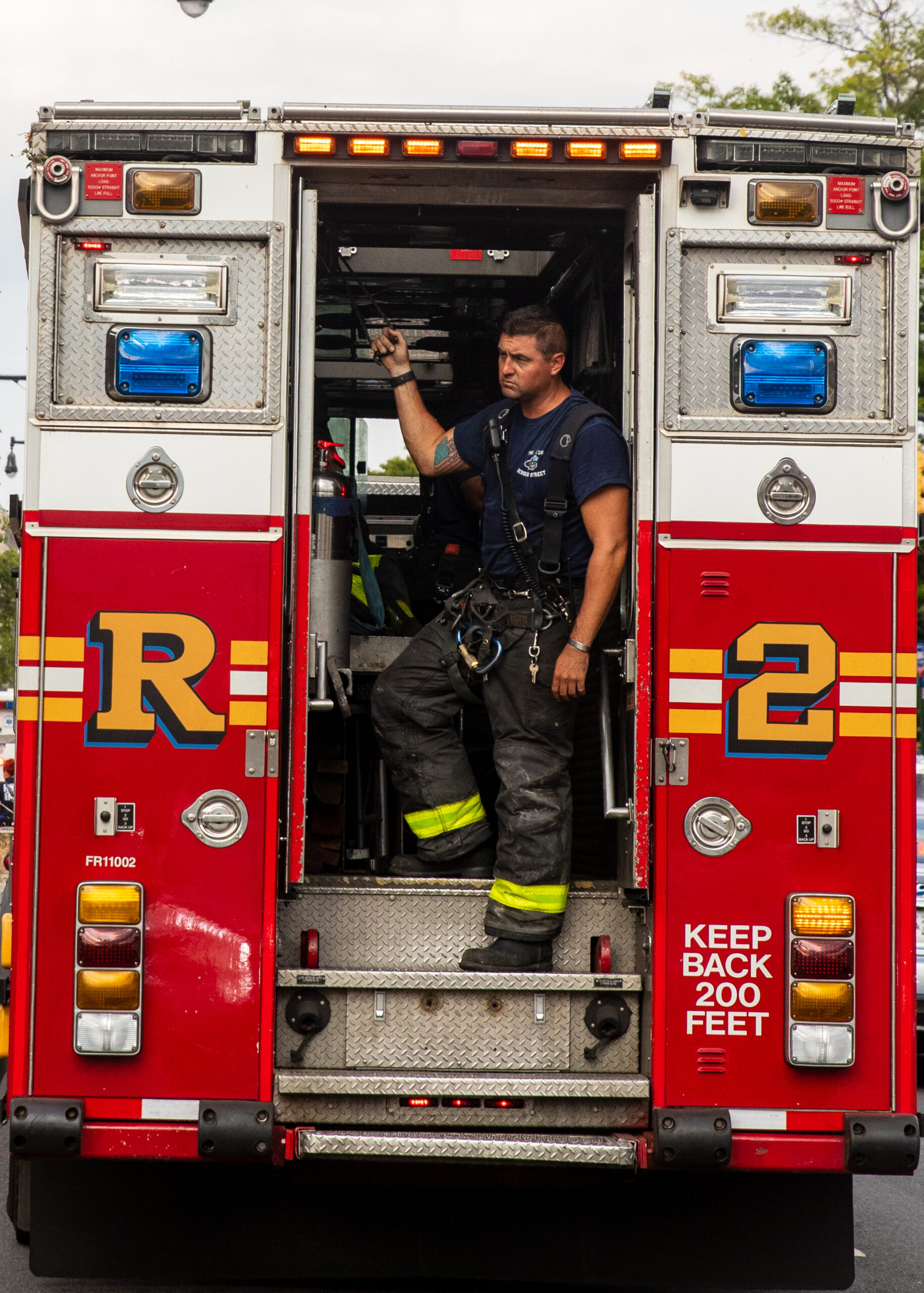
James Dowdell, a lifelong New Yorker and lieutenant in the FDNY, reflects on his upbringing in Rockaway Beach, the loss of his father at the World Trade Center on September 11, 2001, and the path that led him to follow in his father’s footsteps as a New York City firefighter.
This interview is part of an oral history project undertaken by Alex Bower-Leet in affiliation with the University of Kentucky.
Life Prior to 9/11
I am a 41-year-old New York native. I am currently a lieutenant in the FDNY, a father of three amazing kids, a husband to a beautiful wife, and just someone trying to live with the lessons and the morals that I was raised with. We grew up in Rockaway Beach, Queens.
Before 9/11, life was pretty simple. My father was a New York City fireman who also had a hardwood flooring business. He worked very hard. My mother was a public school teacher. I have an older brother, Pat, who’s 16 months older than me. My parents worked really hard. We did a lot of family stuff. Everything was based around family. If Pat had a basketball game, like we all went, it was just a good environment to kind of grow up. And I guess I didn’t realize how much effort they were putting in until I got older. And how to deal with the chaos of kids and family and stuff like that. But life before 9/11 was just, my parents had a great marriage. They were just hardworking people who supported each other and put family first. And it was just a very simple time, I guess, when I look back at it. My birthday is September 10th. So before 9/11, I had just turned 17, a senior in high school. My high school was on 16th Street between the 5th and 6th Avenues in New York City, Xavier. And yeah, just everything was, like I said, pretty simple, I guess, compared to the chaos that ensued.
I said I learned more about life going to and from school on the subway than I did in school. You know, it was getting out of your neighborhood and getting into the city and kind of it is definitely eye-opening, right? Experiencing all the different cultures and people that come with coming into New York City. And then, we were lucky we had the beach down the block. We had the kind of the best of both worlds, I guess. But it was definitely an adjustment going from a little school that we went to in Rockaway into Xavier for the next four years.
Inthe days before 9/11, like I said, my birthday was September 10th. I had a brother, Pat, who was a year older than me, so I was a senior in high school and Pat was a freshman at Iona College up in New Rochelle. He had previously applied to West Point out of high school and got waitlisted. So he wasn’t in the United States Military Academy at that point. And, we had come together, my brother, he just started college and then he came home that weekend to celebrate my birthday and start his reapplication process, which he and my father were doing together. And so in the days before 9/11, it was just, family, it was a positive kind of atmosphere, right? I was turning 17, really excited to be, my brother was away. I was like the only, I went to school with my brother my whole life. Now he was, he had moved on. He was in college. So I felt like it was a great time to be in school. I was excited that Xavier, you had some liberties as a senior, going out for lunch. You were allowed to leave the school and stuff like that. It was just very positive, kind of just looking forward to the future, getting ready to apply to college as myself and then on a family note, I know my parents were very excited, they were going to be empty nesters pretty soon. They had a ton of plans to travel. And my dad was going to start looking at retirement in a couple of years. He was about four years out of retirement. So it was just a lot of good stuff, a lot to look forward to. And just, I’d say upbeat would be the best way to describe it.
So just that kind of leads us into the 11th, you know, which started out like, like any other day, really. Being in New York City, it was, the school went into lockdown, right? Which was not something that, it’s not like the crazy world we live in today where kids are practicing lockdowns and all this stuff, right? It was very, that was a kind of a foreign term at the time for me. And so on the morning of September 11th, I was sitting in first period and they said, listen, everyone stay in the classrooms. Don’t leave, you know, shut your blinds, lock your doors. This is not a drill. And that’s kind of all that was said. And it’s funny looking back on things where you realize like we’re so used to having instant, you know, instant notification, instant information nowadays with cell phones and stuff. Like I didn’t have a cell phone. You know, there wasn’t social media. So nobody really knew what was going on as far as what was taking place just really two miles south of where I was. So once we were in lockdown, then some teachers started coming in, kind of talking to each other quietly. A lot of, I just remember the faces of the teachers, kind of wide-eyed, like, what? Like, what are you talking about? And then there was an announcement over the loudspeaker and it said, if your parents work at the World Trade Center, come to the library.
Xavier was just a phenomenal school. As soon as they heard, they set up all the phones from the phone-a-thon in the library, and they had all these kids, like they were running there to kind of, they were explaining to them what happened, and they were trying to reach their loved ones. And at the time, my father was in Rescue 4, which is a special operations company out in Queens. There’s one rescue company in each borough of New York City. And so my father was the lieutenant on duty in the one in Queens. And my mother is a public school teacher in Brooklyn. So I really didn’t, I didn’t go to the library. I didn’t, it was not something that I thought was going to directly affect me, nor did I realize the scale and the gravity of what was happening. And it wasn’t until they closed the school and everyone had to get signed out. So, we all started going to the library to try to get a hold of someone because you had to get, someone needed to come. They couldn’t just release a bunch of high school kids in New York City. So we had to get signed out. And when I did get a hold of my mother, she was in her own lockdown in her school in Brooklyn. And she said, you know, I’ll try to get a hold of dad and we’ll figure it out. Just sit tight. And I sat tight for a while, and then it wasn’t until a little later where I finally got a hold of her again. And my mom had come up with a plan B, which was to have a family friend who was in the city come kind of sign me out and get me out of there.
And leaving New York City on 9/11 was tough. There were no trains, buses, right? Pretty much the only people I know who got out of Manhattan, you either got on a boat, like a ferry, or walked. And that’s what we did. We walked from 16th Street to the east side. We went down kind of around the battery in Manhattan and got on the Staten Island ferry because our family friend lived in Staten Island. And it wasn’t until we were on the ferry kind of pulling away, you know, kind of mid-trip where I remember looking out the rear of the boat and seeing like kind of like the plume of black smoke and dust and it was just kind of surreal. I remember there was the ferry ride, there were a lot of emotional people, it was still like one between 1:00 and 2:00 in the afternoon, right? So things are still active. But I also remember people sharing waters, helping each other, bandaging people, like people kind of remember just people being really helpful and really kind to each other, which I guess is one of those things, right? Like on the worst of days, people bring out the best in people. And I kind of saw that firsthand on the ferry.
And I couldn’t get home. I couldn’t even get home that night. I couldn’t get out of Staten Island because the bridges and tunnels were closed. So I ended up staying in Staten Island and just being in contact with my mother, who got home. And I said, dad, have you heard from dad? And she said, no, we haven’t heard from dad. But my father had 20 years experience in the FDNY. He had been in special operations for more than half of that. He had, you know, he’d deployed to Oklahoma City when the bombing happened. He was just very skilled. You always think your father like he’s Superman, right? He can handle anything. And I was no different. That’s what I was thinking and just kind of he’ll call, he’ll call later, right? He’s busy helping people and, as hours turned into days and days turned into weeks, it kind of just, that hope and that kind of wishful thinking just kind of dimmed and, eventually we kind of just realized like this wasn’t going to play out the way we wanted.
But I think that was probably the hardest part about all this was just not knowing for so long, right? Like is dad coming home? Is he going to walk in the door? I remember sitting at the table with my mother and my brother Pat had come home from Iona and we were just sitting there and every time the door opened, like you would kind of look at the door and hope it was him. And then, you know, unfortunately it was just friends and family coming to kind of be with you in this tough time. We just kind of waited. And then it wasn’t, it was like a week and a half later where my mother just being like an absolute rock, she was like, listen, you’re going to go back to school. And we have no, we have no information. And when we get information, we’ll come back together and make decisions. But Pat, you got to go back to Iona College. And James, you got to go back to Xavier. And kind of we got to keep living our lives. She kind of set a great tone right after saying, no matter what happens, no matter what the outcome of this is, like, you will still be held to the same standards that you’re always held to. You will not, you know, we will not use anything as an excuse. You still have a curfew. You still have to make grades. You still have to clean your room. You still have to do all the things that your father and I expected. And so she set that tone right off the bat. And she just said, like, you won’t use this as an excuse in your life, like no matter what. And that’s what we did. We went back to school and just kind of waited for information.
As I remember, you know, after a couple of weeks of talking to my brother, now Pat was, he was a freshman at Iona College, right? And after a couple weeks, if you weren’t directly affected by it, right, you’re like, you’re north of the city. Kids are going to do what kids do. They’re in college, right? And I just remember talking to Pat and him saying, you know, I’m not in the right headspace. Like, we don’t know where dad is still. You know, we still have no information. Like, I’m sick of, like, you know, I can’t go out and like, I don’t want to hang out with anyone. I just want to kind of figure this out. And it kind of a lot of dad’s life lessons kind of came back into our minds about, he always said, be a person of action, don’t sit on the sidelines, like make things happen and that started when we were young. He would talk to us about, if you see someone like one of the elderly neighbors, like you didn’t go, you walked over to them and just said, let me help you with your groceries, right? Like you said, like, that’s how you phrase that. You don’t say, can I do anything for you? And they say no, and then you feel good and you try and then they keep struggling. He goes, you walk over and say, let me help you. And so all those kinds of lessons came back to life. And so I talked to Pat and he said, I think we should go start looking for dad at the World Trade Center ourselves. And I said, let’s do it.
And we ended up talking to the guys in Rescue 4, which were the best guys in the world,they had at least two, usually way more, 24/7 at the pile. So we kind of linked up with them and said, we want to start, we want to start being here with you guys. And I think they took a vote, they brought it up at the firehouse. And I think the general consensus was like, if this was them, they’d want to be there. And there were obviously questions about, is this the right thing for someone, 17 and 18 to kind of see and do. And I think they just all agreed that if this was them, they’d want to be there. And they just said, and they took us in kind of and just, we always went down there. We always linked up with the guys in Rescue 4 and we stayed on the South Tower pile, which was where Rescue 4 was sent to. And we just kind of learned the process and were involved. And it was just good to actually have firsthand hearing things as they were done, knowing who was found, knowing where they were found, kind of walking through, just being there for that whole process, as well as just, it was like kind of a transition. I think my mother made my high school lunch for me on the 10th, right? And then next thing on the 11th, I’m the only man, the man of the house kind of thing. Next thing we’re at the World Trade Center digging, so we just kind of had to grow up a little faster than anticipated.
But, we were just surrounded by the best people in the world. And we got to experience everything, with the right guidance, with the right outlook, people who were just doing it because it was the right thing to do. They had no benefit to helping me and my brother out, except that they just had respect for my father and they, and everyone that we were down there with, we still are very good friends with. We’re very lucky to kind of have those friendships. And they just reinforced all the lessons that my mother and father had been talking to us for all along anyway. Like I remember being down there and someone saying like, are your grades good? If your grades aren’t good, you can’t be here. That’s your, that’s your priority. Like your priority is to continue to do what you’re supposed to do. And if you can do that and this, then that’s what you should do. But if you can’t, then, you should go back to school. Like you should, you should start, you know, go home and focus on your homework and not, and not be here. And it was just, you know, so like I said, great, great lessons, great people and in the midst of the worst, the worst day in the world. So we were just very, very fortunate.
I mean, obviously I say, even now, right, when people lose parents, like, it doesn’t matter if your father’s 90 or if he’s 46, like my father was, like, there’s no good time to lose a parent. And losing them at a kind of a young age. But then it’s funny, over these years kids who were born after their father was killed. I met kids who were, don’t remember them because they were so young, they were, two, three, four. And I just think that, I just think that like kind of being able to be there and know that we had, we had a great base, we had a great foundation with both of our parents and then my mother being still, she’s amazing and she’s still with us and we’re very lucky that, to have her, we’re just surrounded by good people was like a theme. I think that is a reason why things worked out the way they did for us.
There was just a sense of pride, I remember leaving high school dressed in Carhartts and going down and just kind of working side by side with these guys that my father worked with. And it was just very, it was prideful, like I was very proud to be there like that. I was even allowed there when I found out how my brother and I found ourselves there. And it made it tolerable, I’d say. We were also, my brother and I are, we’re in a bagpipe band. We were in a kind of time our own bagpipe band after, before 9/11. And then after 9/11, some of the guys in Rescue 4 were also in the FDNY pipe band. They kind of took us in with that too. We got to be, we, they gave us the fire department kilts and red jackets and we got to play, every weekend we would just get in the car with some of the other guys and go to the, there were hundreds of funerals to play at and attend. And we used to, kind of go from one to another. And, but again, you’re just surrounded with people who are, We were just doing everything right. Like I looked, I looked back at what these, what the firemen, right?
If you, if you were a New York City fireman on 9-11 and you survived, right? Like what, they were trying to do, what the guys in rescue four were trying to do, which was, I mean, they still had to work in the firehouse, right? The firehouses didn’t close. They were still working. They were, when they weren’t there, they were digging for, you know, I mean, every fireman knows hundreds of firemen, right? So they’re there digging for their friends, their own families, right, that they have to, take care of and be there for. They’re taking care of families like mine, right? Like, and who, their friends’ families and their colleagues’ families who just lost their husbands and fathers. And then on top of all that, like, they have to take care of themselves too. So I just, when I look back at what was going on after 9/11 and what the fire department in general and what the firemen did at that stage, I think it’s like, it’s the best lesson in resilience and motivation and powerful and it’s all those things because like, I know a lot of people would crumble under one or two of those little circumstances, let alone the huge impact that they were dealing with.
Life After 9/11
After 9/11, we were looking for my father, right? Like, we ended up ultimately not finding him. We didn’t recover him at the World Trade Center. He was unfounded. So, you know, that was a tough pill to swallow, right? We had kind of put in the effort and kind of were trying to bring him home. And then, so in April of 02 is when we held his funeral, April 20th. So that kind of took us from 9/11 to April of 02 was, you know, was kind of up in the air just waiting to bring him home. And once the pile was pretty much, it was essentially broom swept, and we didn’t find him. He wasn’t recovered when we held his funeral. And then I remember after his funeral, like it was kind of all of a sudden, like everything that we had been working on and doing like the funerals and the digging and everything just kind of, it came to an end. And there was like a now what, right? And for my brother, his now what was, he had during that time had applied to West Point and was accepted. So Pat was in the first class into West Point after 9/11, kind of the first class knowing what they were getting into. They were joining the Army during wartime. And so we’re very, we’re very proud of Pat for choosing that path. And I don’t think anyone would have faulted him for not doing it, but I think he’s just the kind of person he is, it just reinforced what he wanted to do and he had wanted to do that before. And he ended up accomplishing it. He was, he got on, he got into the first class at West Point and then did his time at the academy, which is four years, and went on to do two deployments, one in Iraq, one in Afghanistan, in his five-year commitment.
And then my now what was, it was right before the funeral, I took the entrance exam to become a New York City fireman myself. That was in 02. And then I had to turn 21 to join the FDNY. And so I went on to college. And then the second I turned 21, I was able to join, you know, kind of join the FDNY. It’s just very prideful, like, my father died for that uniform and now I was going to get to put it on. And, you were hanging out with a lot of firemen, right? We were in the piping. We were doing a lot of things, but you didn’t, you know, I didn’t earn the uniform. And then so they kind of followed in his footsteps and going to probie school in January of 06 was just that was my, you know, now what? That’s what I started doing. And then it carried me till today. I’ve been a New York City fireman now for said 20 years and just kind of keep looking forward and just kind of keep, remembering, remembering my father and his lessons and his legacy, as well as, 343 firemen that were killed and just kind of keeping those traditions and stories alive is our goal now.
I ended up, much to my mother’s dismay, I dropped out last semester of senior year to get in, to go into the fire department. But I did go back the year after and went back and I did graduate, but I graduated in 08 instead of 06. That was the promise. That was the deal. She said, you got to go back. I said, I promise I will, but I have to do this right now.. The thought of missing it or postponing it, like this is all I ever wanted. Like when we were growing up, I wanted to be a fireman. My brother wanted to go to West Point. That’s what we had talked about this with my father hundreds of times in car rides and, what do you guys want to do? And he was super supportive of our decisions. And then to finally be able to do it, the thought of turning down the opportunity to finish school just wasn’t really in the cards for me. So I just, I left senior year, went to probe school and then once I got off probation, I went back and finished up.
We’re both still in the band. The band is the best. It’s got the best guys from all over the FDNY, right? Like guys from the Bronx, Brooklyn, every borough. And it’s just, you know, it’s the greatest. It’s like it’s the greatest group of people in the fire department. And, you know, they know how to take care of business and they know how to enjoy themselves when the time is for that too.
It’s very important to kind of tell these stories so that people don’t forget and that, you know, that people learn from it. And yeah, I just, I think it’s probably kind of coming up on the 25th anniversary. Like, you know, as time moves forward, like, we got to obviously look forward, but also remember, remember the past.
How to Commemorate 9/11 25 Years Later .
I mean, it’s tough, right? Because from my experience, being on the fire department, 9/11 is very talked about. It’s very present. Every fire truck has a 343 sticker on it, right? Represent the number of firemen that were killed. You know, there’s a memorial in every firehouse for 9/11. So it’s very top of mind and all of my friends are, you know, we were all sons of firemen. Now we’re all firemen ourselves. So it’s, in my circle, definitely very top of mind, I guess I would say so. But I think the most important thing for me is to, I think 9/11, obviously, there’s the obvious stuff that we talk about, right? Which is the chaos and the horrors of that day. And those are the facts and that’s what happened. But there are tons of stories of people doing just extraordinary things in the days after 9/11, right? Like nobody, it seemed like nobody was beeping their horn. Nobody was cursing at each other. Nobody was, you know, everyone was a lot more patient, a lot more kind. And I think that, you know, if on 9/11 and, really every day, if we could all just do a little bit better at how we treat each other, right? And maybe take the extra minute to help somebody and or read about the, I mean, I obviously I talk about the fire department because that’s all I know, but there’s stories of such heroics and such calm, these guys giving radio transmissions like that they’re heading up on the 30s to the, to the towers, like Paddy Brown’s story and Ariel Palmer, like these guys, what they were doing and what they did and how they did it and just their mindset. It was just, they were like, we’re going to put this out. Like, we’re going up to help. Like, those stories I think should be told about, because they really are the, they’re the epitome of selflessness and heroics and all those kind of cliche terms.
But I just think that if we keep telling the stories of the people, and how they, how everyone just kind of came together to face this head on, as well as, just kind of, I think the way to remember it is to just be kind to people, put an American flag in front of your house, kind of honor and treat your neighbors, maybe a little bit better than you usually would just to kind of relive that camaraderie and that patriotism that was 9/11. I remember someone saying that I never want to see another 9/11, but I would love to see another 9/12, right? Meaning that, the country was so in tune, so together. It was so patriotic. I would love to see us get back to the 9/12 mentality.


 Previous