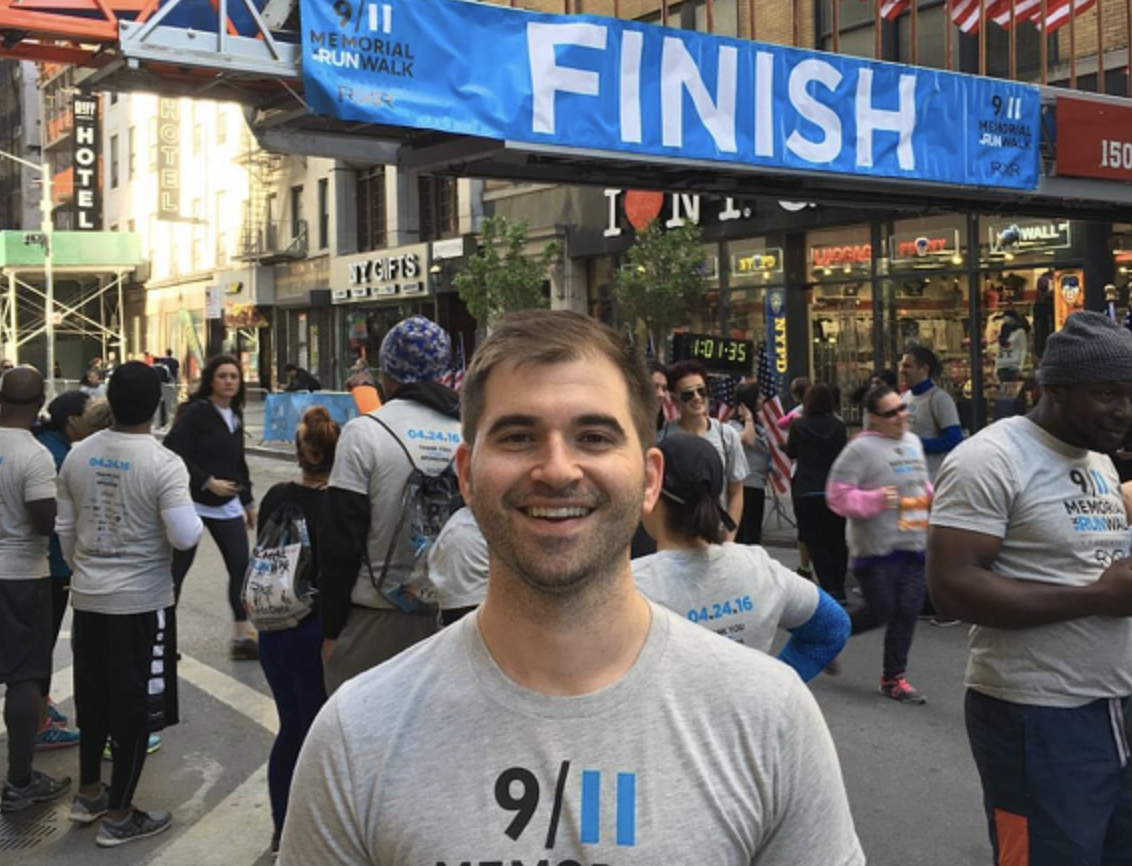
On September 11, 2001, Alex Zablaki was an 18-year-old college student commuting from Staten Island to Baruch College in Manhattan, pursuing his dream of a career on Wall Street, a dream that would be forever altered when he found himself walking through the dust and debris of Lower Manhattan, eventually taking shelter in a homeless mission that would inspire him to dedicate his life to public service instead.
This interview is part of an oral history project undertaken by Alex Bower-Leet in affiliation with the University of Kentucky.
Life Before 9/11
I’m Alex Zablaki. I was born and raised in New York City in the borough of Staten Island, where I currently reside. I’ve lived here my entire life. I’ve worked in New York City my entire life, both in government and the nonprofit space. And I grew up in the great borough of Staten Island, so I got to enjoy one of the outer boroughs and live more of a suburban life in a big city. And I love New York. I grew up in Great Kills in Staten Island, so it’s sort of in the middle of Staten Island. And for 10 years or so, I lived in Tottenville, which is as far south as you can go in Staten Island and in New York State. And then in 2016, I moved to the North Shore of Staten Island, right near the Staten Island Ferry in a community called St. George. That’s where I currently reside.
I’ve lived an exciting life, I think, before and after 9/11. It certainly is a reflection point in my story. But growing up on Staten Island, I spent a lot of time outdoors and in nature. I went to public school my entire life. I got involved in a lot of causes when I was a kid. I’m an Eagle Scout. I was involved in my Boy Scout Troop, Troop 150 in Great Hills, Staten Island. So I did that as an extracurricular activity. I was very entrepreneurial growing up. So not only, you know, paying attention in school and doing what any kid would do growing up in Staten Island and playing around in the woods or on my bike, riding around, exploring. But then also I worked in a catering hall from age 13 until age 21, where I was a dishwasher and then rose to the ranks and was sort of managing the place towards the end and became a waiter, a head waiter. So I was entrepreneurial. I started businesses when I was a kid, delivering newspapers. I would rake leaves, shovel snow. I would buy stuff at yard sales and resell them, trade baseball cards. I was always involved in that. And I continued that when I was also in college.
But life before 9/11, much different than life after 9/11. Not too many worries in the world. Probably didn’t have much of a worldview. Before 9/11, I think that woke me up a little bit to see what else was out there. Beyond my community in Staten Island, I did go to school at Baruch College, which is part of the City University of New York in Manhattan. So before 9/11 and then during and then after, I would commute to Manhattan to go to college at 23rd and Lexington Avenue, taking the Staten Island Ferry, the Staten Island train called Rapid Transit, Staten Island Rapid Transit to the ferry and then taking usually the four and five train up to school from either Brooklyn Bridge or down in Bowling Green.
And I thankfully, my mom instilled in me saving and investing early on in life. So I remember having a savings book. They no longer do this. They also had a thing called Christmas Club. So you can save money toward Christmas, right? And maybe 10 bucks a month, whatever it was. And then that would earn a little bit of interest. Back then, actually, probably the rates were about the same as they are now, but we have had a lull over the last decade or so of having near zero interest rates and saving money for Christmas, for the holidays. But I think entrepreneurism comes naturally to most people. I don’t think you can force it. So you either have the grit and determination to be an entrepreneur and ideas. You find a gap and fill it as a business person. It’s just something I was born with. trading stocks since I’m younger, especially in high school.
I went through the dot-com boom and bust era, and I remember vividly talking about the stock market with my teachers in high school, Wagner High School on Staten Island. So it’d be 1999 into 2000 and then the stock market boom and then bust of March of 2000 led to the dot com crash. And I also had experienced that. So I had money in the stock market at that point, trading under my parents account, you know, through the Uniform Gift to Minors Act. And I also worked for a broker in high school in Bay Ridge, Brooklyn, who had a small financial shop that I worked at in high school when I got off early in my senior year. And then I would go there and help be a broker’s assistant. So I always had that entrepreneurial spirit in me and had this desire to go to Wall Street and trade stocks, become a trader, maybe work on the floor of the New York Stock Exchange, work in the World Trade Center, one of the big finance companies. That has been a desire of mine since I’m a kid.
I majored in finance. I have a bachelor’s degree in finance and investments. In the City University of New York, you spend the first two years or so working on the basics and then the last two years focusing on your major. So we’ll get to my 9/11 story in a few moments, but I did study finance and investments. I was headed to Wall Street. That was my dream. That’s what I wanted to do. And I stuck with that. So I took everything from technical analysis to investment banking, options trading in college. I learned it all. I was both self-taught. I was doing it much younger than when I was in college, and then I learned even more advanced skills when I was at Baruch. And then later on in life, while I graduated with a bachelor’s in finance investments, I did get a master’s degree in community and economic development from the State University of New York.
9/11 Experience
So I remember that day really well, and I play it back in my mind often. I had an early class on Tuesday, September 11th, 2001. It was a law 101 class, followed by a basic business class. And then whatever other classes were after that, it’s not really relevant. So I would get the early train out of Great Hills, Staten Island, if I remember, like 5:50 AM, super early. Remember the sun coming up, the orange sky. I’m pretty sure my mom dropped me off that morning on the train. This was pre-cell phone. I didn’t have a radio. I didn’t have a cell phone. None of that stuff. Some people did, but I didn’t have that. I was a poor college student. I was pretty basic. And I got on the train, saw some familiar faces, probably said hi to them. And I’m going to talk about the night before in a minute, and then wound up getting the Staten Island Ferry into Manhattan to make that early, if I recall, 7:35 a.m. Law 101 class, which was in one of the older Brooke buildings at either It wasn’t 18th Street, it’d be 23rd and Lex, the older building. So just to make you aware and anyone that ever sees this and wants to do some research, Baruch College around 2000, 2001 had built what’s called the vertical campus. So they were starting to shift some of those older buildings. They had one on 18th Street down on Park Avenue. They had a building on 23rd. And then above that, they were consolidating everything into the vertical campus, which is their main building now. And now they offer dorms. They didn’t offer dorms when I went there. So it was a commuter college. So that’s how I got there.
The night before, I remember staying up really late. I didn’t get a lot of sleep like most college students wouldn’t do. And I watched Jay Leno. Oftentimes, I would stay up to watch Jay Leno. and the Late Shows on NBC, because I loved it. So I remember staying up really late. I know I was super tired. And then more of the finer details, you know, without memory, like exactly knowing what I got, but, you know, likely got a muffin and something to drink from a one of the little food carts that was on my walk to the Bowling Green 4 and 5 station, which I would have taken at that time to Brooklyn Bridge and do the switch to the 6th to get off at 23rd. If it was really nice out, I would walk to City Hall, Brooklyn Bridge stop and just take the 6th directly. Usually for a 735, it’s pretty early, so you’re kind of timing things. So I don’t have enough time to walk. So I don’t remember if I walked or not. It’s not that relevant. So that was my early morning. 9/11 to my law 101 class.
So law 101 class, 735. There’s no September 11th, 2001 yet that we remember. Normal class. It would have ended around 850 probably or so. I would imagine it was an hour and 15 minute class. I exited the class and I went to a Dwayne Reed that was on the corner of 23rd and Lexington Avenue. I remember exactly what I bought. I bought a Red Bull and I bought candy corn because I love candy corn. And it was around that time when they were just starting to stock for Halloween. So I was waiting in the line. And they had a radio on, the overhead speakers. And I vividly remember an announcement on that radio, let’s say it was 1010 Winds or whoever was on, it might have even been Z100. Whatever was playing had said, there’s a fire at the World Trade Center. So that was very early. That was before people really knew a plane had hit the tower. So that kind of pegs the time a little bit as to when I would have been in Duane Reade. I thought about it, but I didn’t think much of it. The only thing that sort of concerned me, but again, not concerned, nobody was really concerned, was that my uncle worked at the World Financial Center. I had met him maybe either a few weeks prior or the summer before for lunch. We went to go get hamburgers and in a place, something hound, it’s no longer there. And so anyway, I was familiar with the area and I could talk a bit about my relationship with the Trade Center pre-9/11 because there is one. But long and short of it was, I was in that Duane Reade. After going to the Duane Reade and getting a Red Bull and candy corn, no cell phone, no radio on me, no idea if anything’s happening in the world. It’s a much different time than we live in today.
I go into a big lecture hall in the older building that’s on the south side of 23rd Street in Lexington, which they no longer use. And it was a business 101 class. I can’t recall what time that class was supposed to start. 10, 9:30, probably somewhere around there. The classes were pretty stacked so I had my schedule anyway for the second year. And I was sitting there, I was probably eating my candy corn. I definitely went through my Red Bull. And by the way, I never get Red Bulls. So this was like a rarity to me. For some reason, I was just tired that day. I needed it. And people started coming in saying something happened at the World Trade Center. And then there were rumors swirling through this lecture hall before the class even started that people had cell phones, people had radios, and then there were some like, oh, my God, this happened or it was a plane. Someone said, I remember just people just saying things like, oh, the Sears Tower is under attack, this in Chicago, some other stuff. So I still am not that worried. I remember being kind of calm and just like listening, like, what’s going on? Like, what could possibly be happening?
You would never expect anything to happen. And then the professor entered the room. He got up to the podium. He started class like he normally would have, but then said, I’m sorry, I’m late. I got stuck because I ran into the subway when I was getting in. And he may be coming from New Jersey. He had said wherever he was going, he was transferring to a subway. He looked up and there was a gaping hole in the World Trade Center. It looked like a plane had crashed into it. And then people started panicking and said, oh my God, something else had happened. I don’t know what it was. Maybe it was the Pentagon getting hit, right? Whatever the time was. So I freaked out.
You know, people should see emotion. I do often get emotional, but I’ve used to get more emotional about it. It’s been a long time. I think about it often. And, you know, I’m going to actually pause and go back to the Trade Center. And my desire to go into finance, which I’ll get back to at the very end also. So I kind of like going, I’m not bouncing around, but it’s going to make sense. In my first year of college, I started Baruch in 2000. So it was a year before 9/11, August of 2000, I graduated from public school that summer, May, June, Wagner High School. I was in the first class of 2000, which is pretty incredible. And I go to Baruch. I was so excited to explore a career in finance. This is where I get emotional. And the reason being is that when you’re growing up, you have these big dreams. I wanted to stay in New York City because I felt that was my ticket to success. For me, growing up as an entrepreneur and trading stock and working for a broker, I really had this dream desire, this vision in my head that I would be a trader on the floor of the exchange, as I mentioned earlier, or work in the World Trade Center. So I would go sit on the steps of the federal building in front of the New York Stock Exchange and eat lunch during school breaks, and I would talk to traders. in hopes that maybe I could land a job or find out how you get in there behind the walls.
Before 9/11, you used to be able to go on free tours of the New York Stock Exchange. You get a free ticket, which I had done. You got to walk on this catwalk and you got to see them trading. You can no longer do that. It closed after 9/11 due to security reasons. So I did that. And then at the Trade Center, it gets called out. At the Trade Center, they had this incredible mall. And the mall underneath had like a Sbarro’s and the Gap and a Warner Brothers store, some of the stuff you could see in the museum. And I would shop in the store, poor college students, they couldn’t buy much. Maybe they’d go Christmas shopping. But then they had Borders Books. The Borders Books was across sort of where Italy is right now on the Trade Center campus, across from or at World Trade Center 4 or 3, the current location. And Borders Books was elevated above the plaza. So if you went into Borders Books and Borders Books Cafe, you could see all the people walking around in the plaza of the Trade Center. I was fascinated by it. And again, I was a poor college student. I would go to Borders Books Cafe and I’d grab finance books and I’d read them for free. And I’d sit there in the hopes that I’d meet other people that work in the Trade Center and they’d strike up conversation with me and maybe get a job.
And I remember two books I read, Messages of the Market by Ron Insana. He was on CNBC, and I’d watched CNBC a lot. So I remember reading that book pre-9/11, and then Maestro, a book by Alan Greenspan, who was the architect around the dot com boom and bust era. So I paid a lot of attention to that. I remember those two books I read, I probably looked at other books as well. And I would eat lunch there that I would bring. And then I would also, entrepreneurial, I would get, this is going to sound odd, but I would get rolled coins from old banks in Manhattan, so like dime savings banks and other ones, those local banks, and I would look for silver dimes, silver quarters, and wheat pennies. And I pull them, but I would find them then, believe it or not. So I put these out on the little cafe tables and I pick out, you get like 20 rolls of dimes and you can re-roll them and bring them back. And then I would try to find a silver one. And I would every now and then find a silver dime. I would do that just to collect them, another oddball thing that I would do.
And there was a story around that, I don’t have to get into a personal story, but there was a guy that sat at a table and we had a really great conversation just before 9/11 in Borders Books. So that’s kind of my love for the place. I had gone there to just experience city life and finance. And I’m going to get back to that later. So back to my story. So I’m in this business 101 class and I wind up like panicking almost. I put everything in my bag and I leave the class. And I run out. I was just walking fast. I’m a New Yorker. Left the class and I went off onto 23rd Street in Lexington. And I said to myself, I don’t know what’s going on, but I know I need to get home. And as a Staten Islander, there’s two ways you could get home. Well, three, if you have a car, you could drive. But there’s really two ways. You could take the express bus or you could take the Staten Island ferry. In my first few years at Baruch, I never took the express bus. I wound up taking it after 9/11 because it was expensive. Ferry, Staten Island Ferry is free. The train is free. You have to swipe your MetroCard at the end, but it was a free transfer. So again, you know, poor college student, I would go with the lowest cost way to get around. And plus the ferry is kind of cool. So I wind up making the decision not to do the six transfer. And I walked to Union Square to get the four or five. Because if anyone that’s taken the 4-5 knows, you can be downtown Manhattan in a matter of minutes. It goes, it skips, right? It goes from 14th to Grand Central, then to 59th, but on your way down there, you’re going 14th all the way past those local stops to Brooklyn Bridge. It’s the quickest way to get downtown. So I could be downtown in 10 minutes to the ferry. So that’s what I chose to do.
So I get to Union Square to get on the 4-5. It’s right now where the target is. If we want to take a snapshot in time, it’s 2025. So Target now where the train entrance is at Union Square and 14th Street. And then everyone started coming out of the subway. So I got there around the time the subway was shut down. And it was, I guess, perfect timing, because if I was on the 6th, maybe I would have been stuck. Maybe I would have just had to get off anyway. Maybe my life would be different today. I don’t know. So I was not able to get on the subway. However, also as a college student, I’d walk a lot. And I had walked down Broadway a number of times to the Staten Island Ferry. It’s not that long of a walk. I actually did it yesterday from that same area. So it’s just something you do. It’s a fun, nice walk. Not on the morning 9/11, of course not, but, you know, it was a necessity. So I started walking down Broadway right at Union Square because the subways had shut down. And then I start, you can’t really see the Trade Center from the first turn. It’s like a church. Anyone that knows Broadway from 14th Street, you kind of go down and then it angles a little bit right near NYU. And there’s like a church on the left-hand side. So you can go down a few blocks. You can’t see the Trade Center. Well, you can’t see the Trade Center now either, but you couldn’t see anything. You could see the Woolworth Building at some point and straight shot down Broadway.
So at some point when I got down, you could start seeing there was chaos. There’s also people on Broadway, all walking towards you, and I’m walking down. So, you know, everyone’s evacuation is extreme because they hadn’t evacuated yet, but you know, they’re all walking away. I was walking towards it because I got to get to the Staten Island Ferry. I tried using it, I always carried quarters with me pre-9/11. I tried using payphones on Broadway to make phone calls. None of the phones worked. It would either be a dead signal or one of those do, do, do, do. So you just couldn’t get through to anybody. None of the phones worked. And then I remember there were some construction type guys that were walking down. They saw me walking down. I talked with people as I was going, like, what’s going on? What’s going on? We’re walking this way. Why? And some people would start to say, like, what was happening? And then I walked into Tower Records which is on East 8th and Broadway, no longer there. And I went into Tower Records for really one, well, one reason, it wound up being multiple reasons. I was looking for a phone to use to call home to say it was okay because I was starting to hear what was happening.
I went into Tower Records and there was a television on. They were playing ABC and they were showing the video of the World Trade Center burning, all the smoke coming out. And I had gone upstairs, if I remember correctly, there was a phone and the phone worked. And I got through. Some numbers didn’t work. Some were like dead. I tried calling my mom first at PS 16 in Staten Island. I still remember the phone number and that it was a 718 number and that did not go through. It was a busy signal, but the phone was working. And then I called my home. Another 718 number, landline, and there was no answer. And then I called my grandmother who lives in the house in Great Hills. She lives downstairs, with a different phone number. And I called her and she answered. And I said, Nan, it’s, it’s Alex. She asked if I was okay. It’s like, yes, it’s something, you know, something’s happening. I’m not sure what it is. She was watching TV. And then I remember her saying, you know, get home right away. And then my uncle got on. And my uncle, who worked for Continental Airlines at the time, no longer exists now United. At Newark Airport, he sort of told me what was happening, told me some probably it’d be safe or something. I don’t remember exactly what he said. And just to get home. So I hung up. And I went down the steps of the Tower Records and on the TV, I remember something like the tower appears to be leaning.
I think a few news organizations that morning were saying that they felt like the tower wasn’t looking straight or something, like it was gonna look like a collapse. And the first tower collapsed while I was in Tower Records, which was shocking but surreal. I have to be honest with you. I don’t remember how I felt. I don’t know if that’s just like how people are. Maybe I’ll remember one day. But here’s what I did do. I went to the cashier and I bought a disposable camera because I felt like I couldn’t believe what was happening. And I didn’t know what was happening. So I bought a disposable camera which was the thing at the time. It was not digital. People probably had digital cameras, but I didn’t have one. And then I walked down.
So I left Tower Records. I continued down Broadway and you could see this, the smoke going like way, way down. At some point as I’m walking way down Broadway, you could see the smoke going over. I took pictures, right? So I have that, the photographs of all these people walking towards me. And it was an election, it was primary day. So you had signs up for people running for city council. They’re in some of the photos. I could see the street signs. So I’m able to go back in time to kind of understand where I was and, you know, and kind of track that. So my goal was to get to the ferry. And I only knew one way, straight shot down Broadway. So when I got around Franklin Street, I’m doing this from the photos. When I got around Franklin Street and Broadway, which is like Tribeca, I was just a few blocks north of the Trade Center and you could see all the smoke and like there’s people coming and there’s ambulances going and it was just chaos.
I wound up going left east toward the East River. And I wound up in Foley Square. If anyone doesn’t know what Foley Square is, Foley Square is the civic center. It’s where the courthouses are. Law and Order films there. It’s infamous for that. So you have the municipal building that’s on the south side. You have City Hall Park and then the federal buildings and then all the courthouses that go around Foley Square and that big center thing. So Foley Square is as far as I could go. I couldn’t get further south, Foley Square. Somewhere, in between that time, the second tower falls. The second tower didn’t fall with me like watching it fall. The second tower had fallen. When and how that happened again, I don’t know, total blank, as to what would have happened, but there was dust all over the place. And then it was, I was in Foley Square, and the second tower had fallen. Complete silence, surreal. You’d hear that wailing sound, that the fireman’s like jackets going off, right? Or whatever the alarm was from their thing. And people would emerge out of the dust. I wasn’t right at the dust line, but you would just see like people coming out covered in dust or bloody, or they would be throwing water on their eyes. I recall a woman consoling a guy that was choking on a bench in Foley Square and saying it’d be okay. I remember her like rubbing his hair or something and he was like just choking and he couldn’t breathe. And I had enough. It’s like, I don’t know what to do. I kind of got stuck. I went into a deli that was still open. It’s in one of my photos, a green awning. And I bought bottles of water for, well, for myself. And then I wound up giving them out to some people that were coming out because they were just covered in stuff and couldn’t even see. And then outside of that deli, I was handed a flyer. And this is really what changed my life.
So I was handed a flyer. It was on pink paper. And it said, I don’t have the flyer in front of me. It said something like, you know, come to the New York City Rescue Mission, the address on Lafayette Street. And for water, I don’t know if it said food, I’m going to send you the flyer, but you know, whatever it said bathroom. And I was handed that flyer on the street. I took it. I had no GPS, right, no Google. I found that street and I found that address. And I wound up inside the New York City Rescue Mission, which is now today the Bowery Mission, and they merged. And it was one of the oldest homeless shelters in New York City. And there I was in a homeless shelter in Tribeca, just or above the Civic Center at New York City Rescue Mission on Lafayette Street. And all of these other Staten Islanders start coming in. I’m finding this out because I’m talking to people that they’re from Staten Island too. And they had the same desire as me to go to the ferry and got caught in this like smoke thing that was happening, right, where no one could see the dust. Where no one could get below the Trade Center, you couldn’t get north or south, you kind of stuck.
Of course, you could go over the bridges or go north, like everyone was walking when I was going south to a safer place or go to Brooklyn. I had gone straight to the ferry thinking I could get through because no one knew the towers would collapse or had collapsed. You kind of didn’t know what was going on. So with all these other Staten Islanders trying to use phones. It didn’t work. I had a phone number, 732 number to my aunt in New Jersey, my uncle who worked at the World Financial Center, but that didn’t go through. So the phones were no longer working at that point. I got water. I met these other Staten Islanders. My memory starts to get a little fuzzy, but it was a woman, a Black woman who was from Staten Island that had gotten off the ferry in the morning and saw the planes hit in this big plume of fire. She had worked at the Trade Center. She did not get to work, but she stayed in the area and then got stuck when it collapsed and then wound up in the rescue mission. Two other people, two women and a man. Two of those three people lived in Staten Island. One guy formerly lived in Staten Island, but had gone, moved to New Jersey, if I remember him saying that correctly. And they worked in the World Financial Center. And I asked them, you know, my uncle worked there and they were like, well, we were okay and everyone got out and blah, blah, blah. So fine. So we were all there. It’s for other people plus myself. And there were like other people, a lot of other people.
And at some point, we had to leave. We either chose to leave or we had to leave. Mayor Giuliani had called for evacuations of everything below Canal Street. So maybe it was because of that, whatever it was, we had to leave. So we all left together. And I was an 18 year old college student. So even though I’m 18, I don’t really know what the hell to do, like what’s going on. So we went as a pack. We walked north. I remember as we were walking fighter jets went over because people, including myself, crunched down thinking we’re being attacked again after hearing these planes that hit Trade Center. And then, other places like Penn, all that news we started, you know, I’m starting to hear at that point. And I remember people screaming when those planes went over, but they were over to keep us safe, right? But you don’t really know what’s going on. But then some people would say, well, they’re fighter jets and not going to hurt us. But, you know, no one really knows what’s happening. There were cops set up. And we would ask, you know, the police, is the ferry running? And they would say, just keep walking, keep walking. So right, we’re headed to Brooklyn at this point to evacuate. And then there was a police officer toward where, like the FDR is, we could go down South Street, that said, I think the ferry is running. And then there was a New York Post editor, who I really wish I would have gotten the name, who was running. And he overheard this with our group. And he said, I was just at the Staten Island Ferry. That’s where I came from. The ferry is running.
This police officer allowed us to walk south. So our little group, these three women, a man and myself, walked S along South Street or whatever the street is that goes into the FDR. And we walked to the Staten Island Ferry through the dust. And when I got to Wall Street and South Street, it was as if a nuclear bomb went off. And you were walking through piles of paper and office stuff. There’s like a filing, I mean, it seemed like a filing cabinet. It was almost like when the plane hit the Trade Center and the stuff blasted out of the walls, that it dropped offices all over the place, right at South End Wall. And it could have been from the collapse, just piles of paper and just the way that the wind was blowing, it landed there. You have an, well, I, by the way, it ran out of film at that point. So the last pictures I took were around the New York City Rescue Mission, 24, 27 shots. And you wonder what to do at a moment like that. You’re breathing in all this garbage, but you have no idea what’s going on. You look up Wall Street and, you know, even from that vantage point, because the street light kind of turns, you couldn’t see the New York Stock Exchange or Trinity Church, but I remember seeing like hearing the wailing sounds, that’s the fireman’s like jackets going off. But then also, like you could see ambulances in the, like things are happening, but you don’t really know what’s going on. Like people are still out there and they were like, they still have to evacuate themselves. Like maybe they stayed in place, right? They got stuck. So there’s like people out there, but you couldn’t see them.
It was thick smoke or dust. And then I started going through the papers as we were walking. The group was walking pretty quickly. So we were definitely right at where the ferries go. The ferries, they’re much more popular now at New York City ferry, but then there were a lot of Jersey ferries that would go out of that point. And it was part of the great evacuation of Lower Manhattan of all these ferries coming in and saving people. So there were ferries there. I remember people with life jackets on, and we didn’t stop there. I went through some of these papers and I picked a lot of the papers up, put them in my backpack. So I picked up business cards. I might as well disclose this, and I donated all of this stuff to the museum. I didn’t keep any of it. I picked up business cards. I won’t say who they’re from, but sadly, they were people who had died in 9/11, particularly someone from Marshall McLean. I picked up just general business papers that had no, like, no definition of who they were from. They’re just all burnt papers, like they’re all burnt edges, they were all on fire at some point. So I had those. Those I donated to the museum. They actually put them on display when the museum first opened. I found mail from the plane going from Boston to California covered in jet fuel. Those had to be donated, but then also get the postmaster general involved. So there was that going to Van Nuys, California and had Boston like postal marks on it. So we know a plane that was on a plane ticket. I don’t know if it was an actual passenger or a blank, but there was a plane ticket there.
There was a trade sheet unfilled from a company called Cantor Fitzgerald. Never knew what that was until 9/11. And we all know what Cantor is. Cantor Fitzgerald trade sheet had burnt edges. I could get back to that later on. And then I picked up all this paper and then I stopped when this happened. So you, it was almost as if you were sitting at someone’s desk. And you wonder when someone’s in a moment like this, like, you know, why would you go through these papers? Just go home or like, what’s going on? After the second tower collapsed and we’re in this zone of dust, like life stands still. You don’t really know what’s going on. And it’s, if I could relive the moment, I would. It’s surreal. You’re just surrounded by darkness and this stuff swirling around all over the place and nobody knows what’s going on, like zombies. And you’re walking through like ankle deep, probably higher, just piles of office. Like, what happened? Like, maybe this is where I was going to work one day. So I flipped through a paper and I saw a picture of a woman holding her baby. And it was all pelted and it was clearly on her desk. And I stopped picking up and looking at the papers because it was horrifying to me that you don’t really know what happened.
In retrospect, we now know what happened, but that a plane flew through a building and exploded and killed these people. And their stuff wound up at Wall Street and South Street. And I was walking through it. And it was on the 110th floor of the World Trade Center or the 100th floor, right? Something like that. That’s horrifying. But I didn’t take the picture. I probably should have taken it because I don’t know what happened to it. And maybe a family member would have found comfort in that. But I stopped looking at stuff at that point. But I did put stuff in my backpack, which I later donated. And then eventually, this is all happening probably fairly quickly. I’m making it seem like I was there hanging out for an hour. I’m not, you know, I’m walking through this stuff. Kind of hard to not do this too. I think human instinct is not, I think gawking is the wrong word ’cause gawking is like a negative thing around like a Hollywood celebrity. It’s not that. A disposable camera to capture a moment, we all do that now with our smartphones, cell phones, right, on Instagram. A desire to… in a surreal, like, we don’t know what’s happening near-death experience, like what is going on and then curiosity, but also just shock and like, how could you not look and see and feel and be like, what is happening right now in my city, in my life?
I get to the Staten Island Ferry. I was handed a mask that was like the COVID masks we wear, which we all found like N95s. I got an N95 back then. I donated that also. I also donated my sneakers. I was wearing Adidas white sneakers that I donated to an exhibition in Staten Island later on. It’s how people got home that day. Got to the ferry and we got on the ferry. There were car ferries at that time. I was on the Andrew J. Barbieri. I don’t know if there was a car ferry. It’s no longer in service, but it doesn’t matter. Got on the ferry. On the ferry, all the life jackets were out. This is the big orange boat, right? All the life jackets were out. It was complete chaos. There were bloodied people. There were people covered in dust, including myself. Not as bad as people who were in the dust, right? I’m only walking through the dust, so you just have your hair like stuff, but not totally, you know, covered in it. And I stood outside because I didn’t want to be inside. I left the people that I was in the rescue mission with. You just parted ways. I didn’t trade information with them. It’s not like not something you did back then. Like give me your e-mail, give me your phone number. It’s just like not something I did. So I don’t know who these people are.
And I remember being on the top level of the Andrew J. Barbieri Manhattan side, looking out onto lower Manhattan. You couldn’t see much and there was dust there. So you were on the borderline of like the dust coming in, but not fully covering us yet. And you could see a little spike of the Trade Center in the dust like left. And I remember turning to a guy and this mask on. And I said to him, it’s like, oh, maybe they could rebuild it. Like not knowing that the whole thing was gone. And I don’t remember what his response was. Shortly after the boat left, fast forward, it docks, obviously, get off there. I remember on the Staten Island side, it was very chaotic, but the trains were running. You’re on Staten Island now, you’re in the safe zone. And I took the train back to Great Hills. and walked back to my house in Great Hills from the train station. There were people outside on my walk. They had clearly seen that I was from Lower Manhattan because I had this like crap on me and dust. And they had asked me if I was okay and what, you know, my experience, whatever. I didn’t really talk that much. And then I got home. It’s not important what happened when I got home.
It’s honestly tragic and horrifying. There’s also a lot of beauty in the day with how we responded, but early on after 9/11, it’s always hard to reflect on what were some of the outcomes of 9/11, our entire world changed. And of course, there was so much death and loss, and even afterwards continues to be. But there was a lot of good that came out of 9/11 because of how we responded.
Life After 9/11
So I got home, as I mentioned in my story, and clearly depressed and upset, scared, and watched the news a lot. And then there’s only so much news you could watch. I was in Lower Manhattan, which became known as Ground Zero. And wound up coming home, I mentioned the love I had for the Trade Center and for finance. And this was an area I walked through or went past every single day, right, on my way to Baruch. And who knew what was going to happen with school? And when we return, I do recall saying, I’m never returning to school and I would go back and forth. I’m too scared, whatever. But the next day, the nation united. And, my hope is that we can live again like we did on September 12th, 2001. As I also mentioned earlier, I’m an Eagle Scout involved in the Boy Scouts. So the morning after 9/11, I reached out to my Eagle Scout friends and fellow Boy Scouts. And I said, hey, we should do something to help the recovery effort, a rescue effort at that point, you know, eventually recovery effort. So we set up a drive at a local Walbaum’s, which was a supermarket chain in Northeast Staten Island. And we collected donations for the American Red Cross goods. And we did this also at a Kmart, you know, throwing back 25 years, no longer exists either. And we gathered that stuff. And in Staten Island, the new ballpark that had opened the year before called the Richmond County Bank Ballpark, in St. George next to the ferry was designated as a place to store all these supplies that would go to the Trade Center site on the ferries that would take vehicles. So right next door to the ferry, the… ballpark would act as the storage space. It’s also a triage center and like all the people that, maybe need medical services. Nobody ever came, but it was also designed like that.
And then the trucks go right on the Staten Island Ferry and they can bring them back and forth Lower Manhattan and not have to drive over the bridges. So we had brought the stuff there and then I had volunteered at the Richmond County Bank Ballpark for some time. I don’t remember for how long. And really, I wanted to give back. You may remember, or those who don’t remember and have just seen this for the first time, there were a lot of American flags. People were for the first time putting them on their cars. It was a very patriotic moment where we all came together. There was no party politics. Fast forward, I don’t know when school went back two weeks later, maybe or so, less than that, more than that. Eventually I went back to school. This is when I started using the express bus which would bypass Lower Manhattan, right, and bring me right in to where I was at Baruch and mentioned earlier, I’d only really take the train and the ferry, eventually switching back to the ferry and the train once they started opening up parts of Lower Manhattan to pedestrians again.
And then throughout the rest of my years at Baruch, you know, life did definitely change. I would, you know, I stuck with getting a finance degree, but I certainly got sucked into watching the pile come down at the Trade Center, which would take until May of the following year to completely get to the bottom and clear out all of the debris and the loss of life that was there. And the city would give out tickets. You could get a free ticket and you go on a viewing platform and you can watch this. So during school or I would skip school and I would just go and watch the work at the Trade Center, you know, and hope that they would do something and rebuild. While still reflecting on the loss of life. And there were a lot of art installations and you could walk around the site and every few weeks would get better and better. You know, the zone would consolidate and things would become normal again. I went to an internship interview. I don’t remember what it was, it was probably 2002. The summer. And it was at an investment bank. for anyone that’s watching. This is not meant to be against anybody in investment banking, but I wasn’t pleased with the interview. I didn’t like the culture. And I said to myself, and I reflected a lot. I reflected a lot on 9/11 and just the fact that I really didn’t like the way these people act in this job interview. I kind of didn’t want it.
In my heart, I was saying, like, I didn’t want it. So I didn’t get the job interview. I was entrepreneurial. I was actually selling textbooks. I would buy them at the cheap thrift shops near Baruch and elsewhere. And I was selling books online. I was making a lot of money doing it. I was selling them on Amazon and eBay. Back then it was called Half.com. eBay eventually bought Half.com, but you would sell a lot of books on Half.com. And then I transferred stuff to Amazon. So I was selling books. I was making a lot of money on the side doing that. Back to this flyer, though. So on the morning of 9/11, I was handed this flyer to the New York City Rescue Mission. The New York City Rescue Mission is the oldest homeless shelter in New York City and is privately funded for the most part. Now it’s part of the Bowery Mission, so they received some government contracts, but it’s not a city-run homeless shelter. And I was given this flyer to get services there and get shelter myself on the morning of 9/11. And what I found out later was that there was a role reversal on the morning of 9/11 where the residents, the clients that were at the New York City Rescue Mission, those that were homeless, worked with staff and these flyers that were printed on pink paper. And they went out into the streets of lower Manhattan and handed me my lifeline and handed people in suits and people that were worth millions probably a flyer to go get services and an incredible role reversal.
What we saw, what I saw personally on the morning of September 11th, I was able to witness more so nationally on September 12th. And then later, a year after, it was definitely a year, because I kind of put all this stuff away. About a year later, I reflected and I said, you know what? I want to do something else with my life. Like, what is Wall Street? I want to chase money for the rest of my life. And that flyer. So In the museum, the 9/11 Memorial Museum, there is a clock from the New York City Rescue Mission in the exhibition hall. And you can see that there. And it reflects on that moment where New Yorkers got together and helped one another. And New York City Rescue Mission was one of the first to do that for me and for others, countless others. And then also you had the evacuation by ferry boat. I was also on that, one of the people that were on ferry boats that right left lower Manhattan. I didn’t walk out. I didn’t drive out. I went back by boat. That’s also in the museum. So I took urban land use and design courses. I was like, you know what? I want to get involved in civics. So I took urban land use and design courses at Baruch in the summer. I had to do this anyway because after 9/11, I dropped classes because I couldn’t focus on school. And in order for me to catch up my credits and graduate on time, I had to take summer courses.
So I took urban land use and design and I learned about what’s called the city’s ULER process, the Uniform Land Use Review Application or process. It’s the way that we deal with zoning. And after that, I learned a lot about real estate development and the city’s land use procedures and community involvement. I was like, this would be fun. So I rode my bike in 2003 to my local council member’s office, not too far from my house in Great Hills. And I popped in and it was like, hi, my name’s Alex. I go to Baruch and I want to intern for you all. I see the council members working on a lot of land use matters. I’m going to school for this. I got to do a final project, right? It was around that time that I was like doing all this.. And they accepted me as an intern. I interned for them in 2003. And then I was hired shortly after as what’s called a councilmanic aide. And I worked for the council member as an aide while in college, very part time, making very little money. It was almost like a stipend.
And then the council member Lanza, Andrew Lanza, 51st District, took me to a city planning meeting. They were talking about a land use matter and a rezoning on the South Shore of Staten Island. And after that, he asked me, he’s like, hey, you want to work on these land use matters? Like, I kind of do. So I started working on these land use matters. June of 2003 is when I first got the job, because I know that because my pension also started with the city at that time. So it goes back that far. And then, I was earning a paycheck then. And then the summer, probably took more classes. I graduated in 2004, so a year later. When I graduated in 2004 from Baruch, I got my finance and investments degree, learned a lot about technical analysis and options trading and more of the stock market, but I decided never to go to Wall Street. I wanted to go into public service. And the council member hired me as a full-time staff member, director of land use in June of 2004. And then we did a lot of work around rezonings. We filed 8 ULIP applications in-house. Mayor Bloomberg at the time had the growth management task force on Staten Island, heavily involved in that. The transportation task force really tackled this issue of overdevelopment on the south shore of Staten Island and then also saved a lot of parkland, landmark buildings during that time.
Councilmember Lanzer ran for state senate in 06. We went to the state senate in 07. I went with him there. Served at a point as chief of staff, worked on a bunch of legislative issues. I got bored of that. I wanted to do more. I ran for citywide office because I got the political bug. I wanted to run for local office, but I couldn’t. That’s politics, which I won’t get into. I ran for citywide office in 2009. I was the Republican nominee for public advocate. Mayor Bloomberg was running for his third term. So he’d gotten an extension by the city council to run for three terms. It was always supposed to be two. So he ran in 01 when he won. He ran in 05, which I was involved in that campaign. And then he ran again in 09. So the mayor ran on his line. I was underneath him as a public advocate candidate. And then a guy, Joe Mendola, ran for comptroller. Ran for citywide office as the youngest person to ever run on a major party line for citywide office. I was 26 years old at the time and got like 170,000 votes. I lost, of course, to Bill de Blasio, who was in a runoff with Mark Green in the Democratic primary.
And then after 2009, 2010, I decided that I wanted to leave the state Senate and I landed a dream job as director of community relations for homeless services under Mayor Bloomberg. And I did that for three years. Served in homeless services, ran the city’s what’s called the Hope Count. It’s the largest street survey of homeless people living on the streets in North America. So I managed that for three years. And then Superstorm Sandy happened, another crisis for New York to deal with in 2012. And I was asked by the Commissioner of Homeless Services at the time who went to work for the state and Andrew Cuomo to run the Governor’s Office of Storm Recovery, then called New York Rising. I was asked to join his team, which I did in 2013. So it was right after Superstorm Sandy when that office was set up. It was like one of the early hires. I was under the like first 10 hires in that office. And then wound up working with communities in Staten Island to recover after Superstorm Sandy, Lower Manhattan below 14th Street, East Bronx, Red Hook, and the Coney Island Peninsula. So Coney Island, Seagate, Brighton Beach, and Manhattan Beach. Work with people to recover after Superstorm Sandy through the state. I had about $100 million in projects that I was managing. I did that for four years.
And then in 2017, I left. I left to become the executive director of the Jamaica Bay Rockaway Parks Conservancy, a public-private partnership in Jamaica Bay and Rockaway to support federal, state, and city parkland. Out there, I built a great team, helped build the organization up. And then in 2022, I left there to come run the New York, NYCHS, New York City Housing Authority, NYCHS nonprofit called the Fund for Public Housing. It’s now known as the Public Housing Community Fund. And we’re an organization that supports over half a million New Yorkers across the five boroughs. So back to that flyer I received, it was an inspiration for me to give back. And that wouldn’t have happened without 9/11 and that experience changed my entire career trajectory from wanting to go to Wall Street to wanting to serve. Yet I still trade stock and invest and I’m still entrepreneurial. However, I chose a life of service, whether it be through government or the nonprofit space, and who knows how that might change over the next few years. But that all happened because of 9/11.
9/11 definitely changed a lot of us and certainly changed career paths. And I think we were, most of us or a lot of us were inspired by how people acted or reacted after 9-/1. And that set forth a lot of different people in a lot of different ways, whether it be like my story or others who chose to fight wars and commit to service through the Army, right? And the war against terror and others and how their life changed also. 9/11 was definitely a huge shift. And this is the world we live in today. It’s hard to imagine a life pre-9/11.
Honoring 9/11
9/11 changed the world. And it changed everyone that’s watching this and reading this’s lives, even if they don’t know it, from things like airport security to immigration policy and war to how we secure buildings, entering spaces. All of these things are what we were given in a post-9/11 world. Everything changed on 9/11. I don’t think you’d be too idealistic about pre-9-11, you know, oh, someone went, oh, I left my door unlocked and now I lock, you know, that’s not what it’s about. You know, before 9/11, you had the 1993 World Trade Center bombing. Terrorism had existed. Osama bin Laden had existed. In fact, it was under Bill Clinton that they tried to take him out and maybe had failed attempts to do so. So al-Qaeda was there, ISIS coming later after the War on Terror, during the War on Terror in Afghanistan. So these things and these threats have always been around. 9/11 was, in my opinion, a major lapse in how the United States secured itself, shared information, and could have possibly stopped this. And they didn’t, right? So it is, it kind of is what it is.
But here’s what I would tell the next generation with that said. One, never take life for granted. Life could change in a second. And the life you live today may not be the life you live tomorrow, but for especially younger people that may not have faced like I did personally on 9/11 or other tragic events, major calamities like the Superstorm Sandy, in New York City that I mentioned, or the COVID-19 pandemic, is that you also have to personally build in resilience. And that when you’re faced with such great tragedy, you have to have the ability to bounce back because we have to move forward and live and thrive and not let things like 9/11 take us down.
One of the incredible things about 9/11 is that we could have had this big gaping hole in lower Manhattan in perpetuity, yet under Mayor Bloomberg and others working with family members, the World Trade Center site has been rebuilt and rebirthed while still reflecting on loss and honoring that loss. And I think that’s a testament to who we are as Americans, that we don’t just walk away, that we continue to want to do good. And that gets me to the final point of September 12th, is that for those Americans that were born after 9/11 is to really reflect, not necessarily on the negativity and the destruction, the pain, we should remember that and never forget, but also remember how we responded on September 12th. How we came together and put politics aside. And that even in such a polarized moment in time in our country, and who knows when you’re watching this video, if it’s the same, it often is the same. There’s always a moment within those periods, whether it be the 1950s or 60s, going back further, 70s, there’s always a period in time where we’ll be living in a moment like today. But if we go back to September 12th, we remember how we all came together. So that would be my message of hope and resilience in the face of such tragedy. So I think we can more easily say that 25 years later. But if it was two years later, we could never have said that.


 Previous