


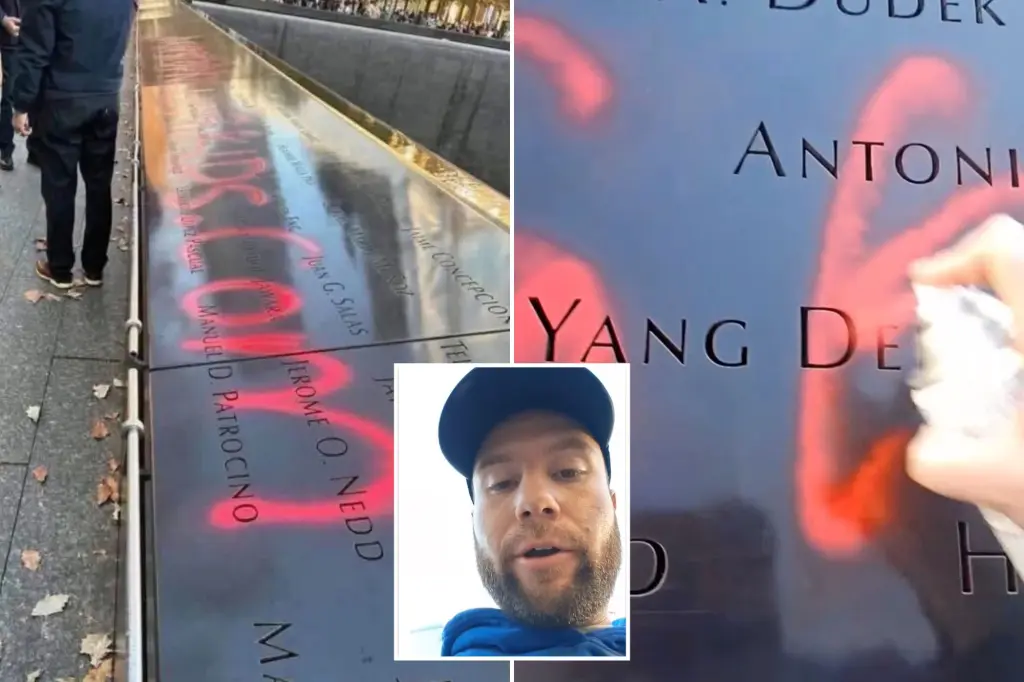
On Monday evening, a man walked up to the North Pool of the National September 11 Memorial, pulled a can of red spray paint from his bag and wrote the address of his gun-control website across the bronze panels that carry the names of those killed on September 11, 2001.
He filmed himself doing it. Then he turned to the camera, gave his name and announced what he had done.
Jon Tijerina, 31, has been charged with criminal mischief, making graffiti and possessing graffiti instruments. Memorial staff and police moved quickly, and the paint was removed. His organization has since called the arrest a win. He has said he wanted the attention of President Trump and Mayor Zohran Mamdani.
The paint is gone. What it represents is not.
I was at Ground Zero on September 11, 2001. For me, and for thousands of families, the names on that memorial are not abstractions.
They are not even alphabetical. They are arranged by what the memorial calls meaningful adjacencies: coworkers beside coworkers, firefighters with their companies, friends who asked to stay together, expectant mothers followed by the words “and her unborn child.” On each victim’s birthday, a white rose is placed in their name. For roughly 40 percent of those lost, whose remains were never identified, that bronze is the closest thing their families have to a grave.
Those names are not a billboard.
This is not about gun policy. Americans of good faith disagree about how to stop the violence Tijerina cited, including the shooting after the Florida A&M homecoming game. The grief behind that is real. But you do not honor one set of victims by painting over another.
I wrote recently in these pages that words have consequences, and that there cannot be ideological exemptions to basic human decency. That principle does not bend because a cause sounds compassionate. Desecrating a memorial is wrong when it is done in the name of the right. It is wrong when it is done in the name of the left. It is wrong when the slogan is one we happen to agree with.
Extremism does not become acceptable because we agree with the grievance that precedes it. Neither does contempt for the dead.
A can of paint is not an act of terror, and I will not pretend otherwise. But I also wrote about how boundaries move. A statement that once would have drawn universal condemnation becomes controversial. Then debatable. Then defensible. Actions follow the same path. Twenty-five years ago, using the names of 9/11 victims as a backdrop for a viral video would have been unthinkable. On Monday, someone did it, filmed it, posted it and declared victory.
That is how lines erode. Not all at once, but one stunt at a time, each rewarded with the attention it was designed to harvest.
The defining cruelty of September 11 was that 2,977 ordinary people were turned into instruments of someone else’s message. The memorial was built as an answer to that cruelty. It gives every victim back a name, a place and a dignity that no cause may claim. Spraying a slogan across those names, for any reason, turns them back into props.
That is why the work of the 9/11 Legacy Foundation begins with the names. More than 100 million Americans were born after that morning or were too young to remember it, and only 14 states require that it be taught in schools. Our free national curriculum, built for classrooms, workplaces and community groups, does not teach 9/11 as dates and casualty counts. It teaches it through people: the office worker who called home, the firefighter who kept climbing, the passengers who fought back, the families who carried on.
We also teach September 12. Americans stood together across race, religion and political affiliation, not because we agreed about everything, but because something deeper than politics connected us. The memorial is one of the few places where that unity still holds, where strangers of every political stripe stand side by side in silence. That is exactly what makes it worth protecting.
So what now? Prosecutors should treat this not as a prank but as the desecration of a gravesite. The rest of us should refuse to reward it with clicks. And we should not stay silent, because silence is how the unthinkable becomes routine.
Most of all, we should teach. Every student who learns one name and the life behind it becomes one more person who would never think to paint over it.
The red paint came off in hours. The names were there before it, and they will be there long after.
We Remember So They Never Forget.