


In one of the most enduring works of classical philosophy, Symposium, a group of thinkers gathers not to argue for dominance, but to explore an idea. Each offers a different perspective on love, some grounded in virtue, others in desire, others still in human longing and the pursuit of meaning. No single voice prevails. Instead, the conversation itself becomes the vehicle for understanding. That ancient exchange feels strikingly relevant today, particularly when thinking about the United States and the nature of its national identity.
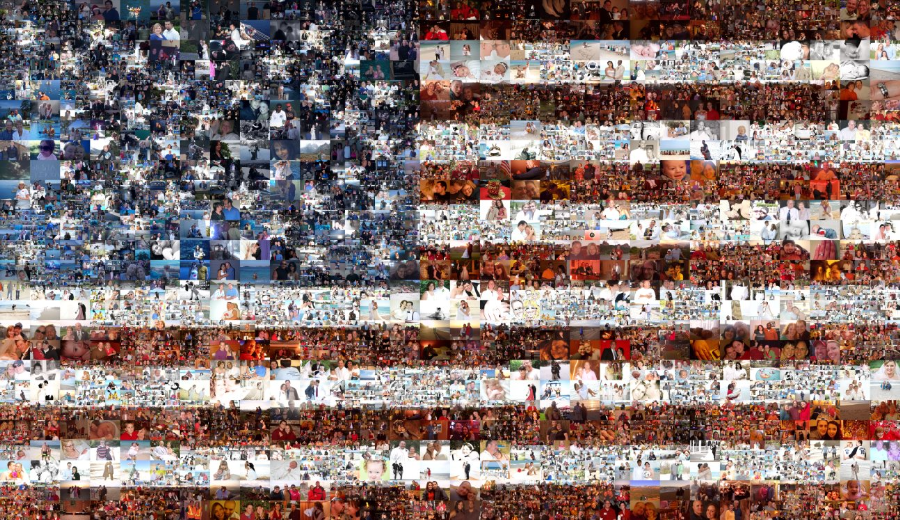
America is often described as a “melting pot,” but that metaphor has always been incomplete. Melting suggests uniformity, the dissolving of differences into a single, indistinguishable whole. Yet the American experience has never truly functioned that way. A more accurate description is a mosaic: a collection of distinct pieces, each maintaining its own identity, arranged together to form something larger and more meaningful. Cultures, beliefs, and perspectives are not erased in this country; they coexist, sometimes in harmony, sometimes in tension, but always in relationship to one another.
That coexistence is not always easy. In fact, it is often uncomfortable. But discomfort is not a flaw in the American system, it is one of its defining features. The ability to sit across from someone who sees the world differently, who interprets history differently, or who arrives at different conclusions about the future, and still recognize their place within the same national story, is one of the most remarkable aspects of this country. It is also one of the most fragile.
And yet, we have seen what this mosaic can look like at its very best.
On September 12, 2001, the United States stood united in a way that many believed was impossible. In the immediate aftermath of the September 11 attacks, political divisions disappeared. Cultural differences faded into the background. Americans did not see themselves as separate groups, but as one nation, bound together by shared grief, shared purpose, and a shared commitment to one another.
It was not that the differences vanished. The mosaic did not dissolve. Rather, the pieces aligned.
For a brief but powerful moment, the country demonstrated what it means to move forward not by erasing differences, but by placing them in service of something greater. That unity was not rooted in agreement on every issue. It was rooted in a deeper understanding, that despite our differences, we are fundamentally connected.
We did not become the same. We became one.
As we approach two defining milestones, the 250th anniversary of the United States and the 25th observance of 9/11, we are presented with a rare and urgent opportunity. These anniversaries are not just moments of reflection; they are moments of decision. They ask us not only to remember who we were, but to decide who we will be.
The work of the 9/11 Legacy Foundation is grounded in that very idea. Its mission is to ensure that the lessons of 9/11 are not confined to memory, but translated into education, civic understanding, and national purpose. It seeks to connect generations, those who experienced that day firsthand and those who know it only through history, so that the unity we felt is not lost to time but carried forward as a guiding principle.⁴
Because the truth is this: what we experienced in the days and weeks following 9/11 was not just a response to tragedy. It was a reminder of what is possible. It showed us that unity is not something that emerges only in crisis. It is something that can be chosen.
The strength of a mosaic lies not in uniformity but in contrast. In Symposium, each speaker contributes a partial truth. No single perspective captures the full picture, but together they move closer to something meaningful. The American experiment operates in much the same way. It does not arrive at truth by eliminating opposing views, but by engaging them. It depends on the idea that disagreement, when approached constructively, is not a threat to unity but a pathway to it.
Yet that idea feels increasingly under strain. Public discourse today often rewards certainty over curiosity, and confrontation over conversation. Disagreement is too frequently interpreted as hostility rather than as an opportunity for engagement. Conversations that once might have led to deeper understanding now end prematurely, replaced by division and retreat. This shift is not just cultural; it is structural. A nation built on competing ideas cannot function effectively if those ideas are no longer allowed to meet.
What makes this moment particularly concerning is that we already know what the alternative looks like.
We have lived it.
The unity of September 12 was not theoretical. It was real. It was visible in communities, in workplaces, in places of worship, and across political lines. Americans showed up for one another not because they agreed on everything, but because they recognized something more important than agreement: shared identity.
The question now is whether that mindset can be reclaimed, not in response to tragedy, but through intention.
From its founding, the United States has been shaped by tension, between liberty and order, between individual rights and collective responsibility, between security and freedom. These tensions were never meant to be resolved once and for all. They were designed to be debated continuously, with each generation contributing its own interpretation. The resilience of the system lies not in the absence of disagreement, but in the ability to sustain it without fracturing.
One of the most powerful aspects of the American mosaic is that it allows for multiple truths to exist simultaneously. Two people can look at the same issue, whether it is immigration, economic policy, education, or national security, and arrive at different conclusions based on their experiences and values. That divergence does not diminish their citizenship. It affirms it. A functioning democracy depends on the presence of competing perspectives, not their elimination.
The challenge, then, is not disagreement itself, but how it is handled. In a nation as large and diverse as the United States, consensus will always be imperfect. The question is whether Americans are willing to engage across differences or retreat into ideological isolation. The latter may offer short-term comfort, but it undermines the very foundation of a pluralistic society. The former requires effort, patience, and humility, but it is the only path that sustains the broader structure.
This is where the lessons of Symposium remain instructive. The participants in that dialogue do not seek to silence one another. They listen, respond, and build upon each other’s ideas. Their goal is not victory but understanding. That approach does not eliminate disagreement; it elevates it. It transforms conflict into inquiry and difference into insight.
America has always been at its best when it operates in that spirit. When it recognizes that diversity of thought is not a weakness but a strength, it becomes more adaptive, more resilient, and more capable of addressing complex challenges. When it forgets that principle, it risks reducing itself to competing factions.
As we look ahead to the next 250 years, the path forward is not found in uniformity. It is found in recommitting to dialogue, respect, and shared purpose.
The beauty of a mosaic is not that every piece looks the same. It is that each piece retains its uniqueness while contributing to a larger whole. The strength of the United States lies in that same principle.
We are strongest not when we agree on everything…
…but when we remember that, despite our differences, we are one nation.
References
- Plato. Symposium. Translated by Nehamas A, Woodruff P. Indianapolis, IN: Hackett Publishing; 1989.
- SparkNotes Editors. Plato’s Symposium: Summary & Analysis. SparkNotes; 2024. Available at: https://www.sparknotes.com/philosophy/symposium/overall-summary/
- Wood G. The Creation of the American Republic, 1776–1787. Chapel Hill, NC: University of North Carolina Press; 1998.
- 9/11 Legacy Foundation. About the 9/11 Legacy Foundation. Available at: https://the911legacy.org/about/
 Previous