
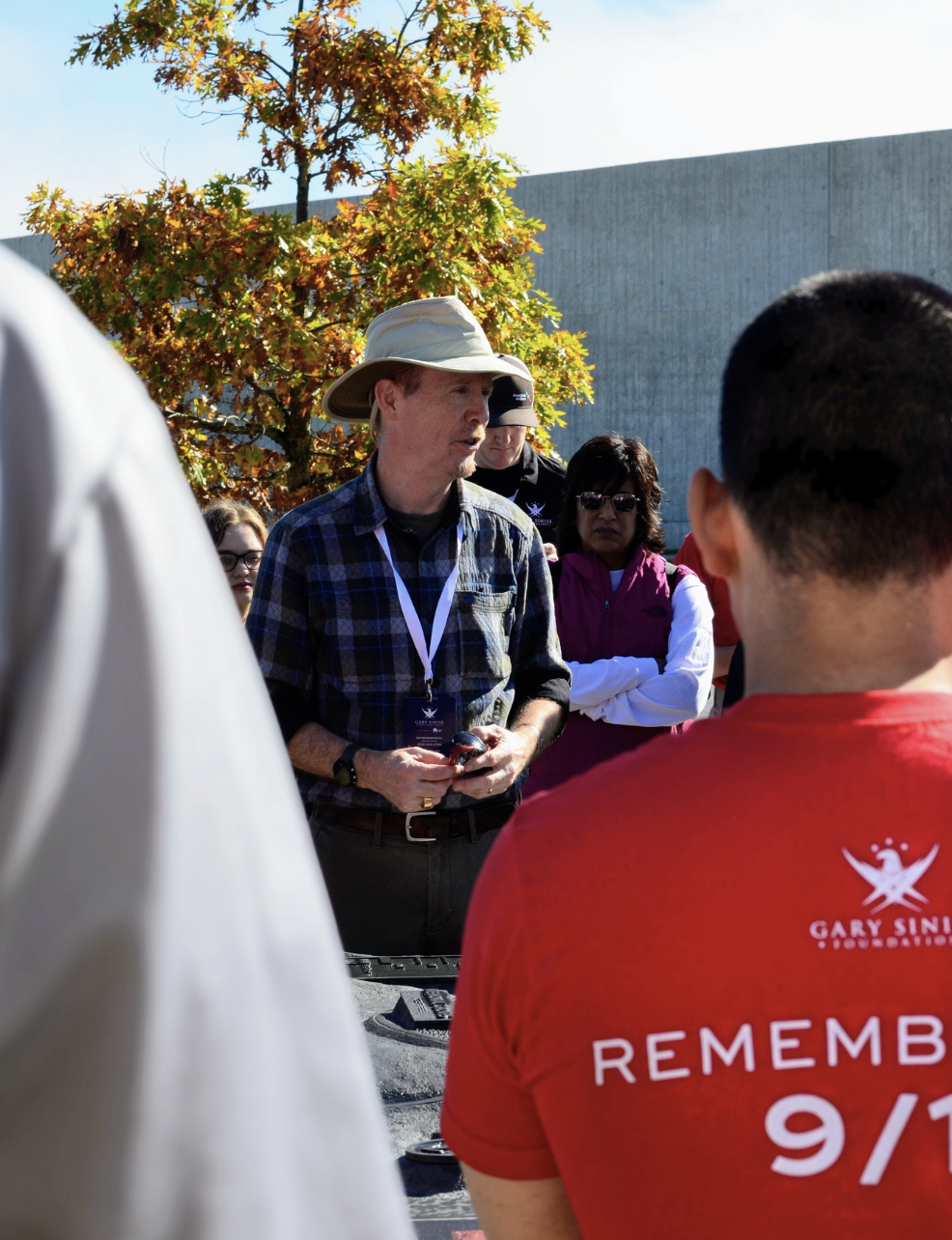
Gordie Felt reflects on his life, his family, and the lasting impact of September 11, 2001, when his eldest brother, Edward Felt, was killed aboard United Airlines Flight 93.
This interview is part of an oral history project undertaken by Alex Bower-Leet in affiliation with the University of Kentucky.
I’m the youngest of three brothers, born and raised in central New York, a little town called Clinton, where my eldest brother, Edward Felt, my middle brother Larry and myself, we graduated from the Clinton Central School District. We’re the sons of E. Porter and Shirley Felt. And Ed, as I said, my eldest brother was a passenger on United Flight 93, one of the 40 heroes that fought and won that first battle, that battle for Flight 93 on the morning of September 11th, 2001. My wife and I live in Remsen. And I personally am a retired special educator. My wife is an occupational therapist. And for 31 years, we owned and operated Camp Northwood, a socially therapeutic residential summer camp for autistic spectrum children in the Adirondacks of New York State. We’ve got two children, two adult children now. One, Rebecca was 9, and Rachel was 4 on September 11th. 2001.
Growing Up With Ed
We lived in a beautiful little college town, Clinton, New York. Hamilton College is located there. And we had very easy access to the Adirondacks. So many of our summers were spent up in the Adirondacks, hiking, camping, going to lakes. And it was a great childhood for us. Our high school was a pretty small high school, where Ed clearly excelled academically far more than Larry or myself at school. But it was a wonderful, almost a Norman Rockwell style kind of childhood. You know, Ed was born in the late 50s. My other brother and I were born in the early 60s. And it was a wonderful time to grow up here. My dad was a lawyer in town. My mom was a nutritionist, but full-time mom for many years before she went back to work. And we loved our little town. We were very blessed, very lucky to be able to grow up under those circumstances.
Me and my wife met at Camp Northwood when I was a grad student in special ed, and Donna, my wife who’s from New Zealand. She was here on a J1 visa exchange, cultural exchange program. So we met at the camp and just fell in love with the camp and each other and eventually bought the program and operated it for many years and raised our kids here again at the edge of a lake in the Adirondacks. And we still make our home here. So over the years, working with the autistic spectrum kids and mentoring young professionals and working with families on helping their children become more independent and more socially confident was really, it was a passion of ours and it was quite a rewarding career.
We actually decided, thankfully, to retire after the summer of 2019. And we sold the program, the camper list and such, to another camp down in Pennsylvania. And luckily so, because COVID it just devastated the camping industry in New York State in particular, since New York State shut down all camps for two years during COVID. So we wouldn’t have been allowed to operate at all. So we got out just in time. So we, you know, our timing couldn’t have been better.
Life Prior to 9/11
Well, by that point in, you know, the late 90s, my wife and I, we actually were living on Long Island, operating the camp during the summer. I was teaching for a while at a college on Long Island, again, working with special needs kids. Ed and his wife were living in Mattawan, New Jersey. And we’re sandy still, you know, to this day, has the house. We’d see each other throughout the year. We’d see each other on holidays. And, you know, Ed was a real mentor for many people, not just not just me as the young brother, but for many people that he worked with, and people looked to Ed for advice, and he was a problem solver. He was just very compassionate, he’d give you the shirt off the back office back kind of guy, particularly after our father passed away in 1997. Ed became the patriarch of the family. He was the one that we all looked towards.
When dad died in 97, my wife and I chose to move back upstate to be closer to my mom, to be closer to our camp program. And at that point, I was doing camp full-time, so it just made sense for us to move back up here. But, we always enjoyed our time with Ed and his family as they would come up to visit us and mom. And, before 9/11, I was obviously very, very focused on our business, on my kids, on, again, it was a good time. It was a prosperous time for many people during the 90s. And we did a lot of traveling and life was good until it wasn’t that morning of September 11th when everything changed. But we look back at those days when we were a fully intact family with hopes for the future and, Ed’s daughters and my daughters and Larry and his wife, it was, we were always, looking forward and looking, I guess, for the next grand adventure. But as I said, then along came September 11th, when life just took an unbelievable turn. And nothing’s been the same since.
Response to 9/11
On the morning of September 11th, for those of us that remember that day, particularly on the East Coast, it was a beautiful, beautiful blue sky, just a lovely morning. I got up and went into camp, we’d finished our summer season, but we were doing our shutdown and I was kind of just walking along one of the roads of camp when my maintenance director drove up in the pickup truck and he rolled down the window and he said, “Have you heard what’s going on?” And I didn’t know what he was talking about. So I went over to the truck and he actually was listening to Howard Stern describe what was going on in New York. And we knew that something big was happening. So we went and got in front of a TV. And like many people, we watched September 11th unfold, before our eyes, by the time we got the TV, the first tower had been struck. And then we were in front of the TV when the second tower got struck. I got a call from Sandy that morning. Ed did a lot of traveling for his business. He worked for a company called BEA Systems, and he was their lead engineer on a product that they would sell to companies that qualified all over the world. And it had something to do with transfers of large sums of money between businesses and such across the internet. We never really knew what he did because we couldn’t really understand it. I mean, he was one of these brilliant guys that would, he had all kinds of patents for cryptology. And, he was very early on the origin of the internet. And, he had this way about him where, you never felt dumb talking to Ed, but you knew that he was so far beyond most people in terms of his level of thinking. So for his company, he would have to make last-minute trips across the world, because when they’d sell him a product and they had difficulty integrating it into their systems, they would send Ed. He was the problem solver. That’s what Ed did best. He solved problems. He could figure things out. And if there wasn’t something available, he would create something that would help solve the problem. So he had a last-minute trip that morning, he actually was flying out to their headquarters out on the West Coast. And Ed always flew Continental. And unfortunately, for this trip, it was last minute. They couldn’t get him a ticket on Continental. And I’ve heard stories time and time again of people that just were in the wrong place at the wrong time. And it was Ed’s case. He was put on Flight 93 on United Airlines, an airline that he never flew.
So I got a call from Sandy on the morning of September 11th. And she told me that Ed was flying and that she hadn’t heard from him and that when he landed and she got in touch with him, she would call to let us know that he was okay. And at this point, everyone that knew someone that was flying was just frantically trying to get in touch with the airlines, trying to figure out where their loved ones were, if they were landing, where they had landed. So there was just a surge of requests for information. I got off the phone call with Sandy, then called Ed’s cell phone and said, “Look, please just call us. We want to know you’re safe.” I guess it was early afternoon, probably about 1 o’clock, we got the call back from Sandy telling us that Ed was on Flight 93. The plane had crashed in Pennsylvania and they didn’t think that there were any survivors. But again, even then there were so many rumors going around, you know, about what was taking place and false reports and exaggerated reports and we almost couldn’t believe it. And until we kind of, got confirmation again through the airlines. And then, at that point, Sandy asked me to go tell my mom. It was the hardest thing I’ve ever had to do.
I went down and told mom that Ed was gone and that it had crashed and there were no survivors. And, that was kind of the first realization regarding September 11th, that life was never going to be the same. It was just devastating. The horror, the violence, the terror, the terrorists, and we didn’t know the story of Flight 93 at that point. We didn’t know what had unfolded on the plane. And we just knew that our loved ones were dead. We knew that they were part of the plot. It wasn’t until later that the story started coming out in the news reports and, once they were able to get some facts together, that we realized the heroic actions that were taken by our loved ones on Flight 93 and how they effectively thwarted the third prong of this attack. But at the moment, those first days they’re a fog. I think for many of us, it’s really hard to remember specifics of those early days, because I think we’re all in shock. I think our bodies, to a certain extent, kind of shut down to kind of help us, just keep us from trying to process the horror of what happened, but to kind of shield us from the horror of that day.
So then from there, once they established it, the plane had come down and, we were in touch with the airlines and we knew that the FBI had kind of taken over the crash site down in Shanksville. They brought all the families down once the FBI released the crash site. So, I traveled down to Shanksville. And, with hundreds of other families, related to the passengers and crew members of Flight 93, they put us up at a Southern Springs Resort. And we had an opportunity to go over to the crash site. Although the first thing they did when we got there was we gave DNA because they needed to get samples to identify the human remains. I mean, it was when the plane came down, it was going about 560 miles an hour. It disintegrated on impact so that there were no bodies. They were amazed when the first responders got there and there were really no parts, large parts to the plane. I mean, it was just, as the terrorists wanted, it was a bomb. It was filled with fuel, came down, it exploded, a very violent explosion. Most of the pieces of the plane were less than five or six inches, you know, wide and long. Although they did find an engine in a pond about 1/4 of a mile away that had got blown up over some trees, mail from the explosion was found 20 miles away, blown up into the atmosphere.
But in terms of the remains of our loved ones, there was really very, very little. They only were able to recover in the end about 5 to 7% of our loved ones. So, that was hence the need to have the DNA, and they were able to actually identify remains for all of the 40 passengers and crew members. So, every family did get some remains back that we could bury, essentially. They brought us to the crash site that morning, once the site was released on buses. It took about 30 to 40 minutes from Seven Springs to get to Shanksville, which is just this little tiny hamlet in Pennsylvania. And it’s a mile or so from Shanksville out into the middle of this field. The crash site was a reclaimed strip mine. There were no roads other than coal trucks, roads to get back to it. They actually had to build a road to get us there by buses, which they did in a matter of about 36 hours. They paved a road back into it, off Route 30, the Lincoln Highway, about two to 2 1/2 miles in. So it took them to get us out there. A lot of my memories, and I think for most of us, our memories are kind of through a fog.
But one thing that I clearly remember about the trip from Seven Springs out to the crash site was as we’re driving along these country roads, every intersection we got to, there were first responders that were standing at attention, saluting the buses. There were, as we passed homes and farms in the way, there were children out front that were waving flags and holding up signs out of respect and to honor our loved ones. And that really was, you know, the second major realization regarding September 11th that I had was that, you know, our loss, our grief, was going to be shared by the nation and the world. It wasn’t just something that we were going to have to contend with personally, but it was something that we were going to have to share. And that was just in itself overwhelming how big this really was. We got to the site, most of the family units, and there were just buses and buses of us, and we got to what’s called the Western Overlook at the memorial, where we were able to look down onto the crash site. Most of us were just kept to ourselves. We didn’t really get to talk to each other or get to know each other because we were just so withdrawn into our kind of individual family units as we took it in. I mean, that was a massive crater. The earth was, the wound to the earth just as the plane went in was just devastating. You could smell jet fuel in the air.
When the plane came down, it crashed into a grove of hemlock trees, which burned. So there’s a lot of charred, you know, trees in the area. You know, there was police security everywhere and the media was absolutely everywhere to kind of witness our witnessing of the site for the first time. I have to say the media actually was incredibly respectful to the families. They didn’t get too close at all. They knew. And we were grateful for that. There was a time and a place and that was not the time. And we were probably there for, oh, it’s hard to remember, but I would think we were probably there for about 40 minutes. maybe an hour. And then they put us back on the buses to get back to the Seven Springs. And then when we got back to Seven Springs, the families got off the bus, they put us into a large room. And someone I think probably from the Red Cross came out and then the Red Cross was there and the Salvation Army was there. And there were all these agencies that were there that were, to support us clergy and psychological services, to support the families. And someone came to us and said, “Look, we’ve got a room full of press. Is there anyone that would like to make a statement?” And no one, no one raised their hand. And at that point, I thought someone needed to say something. And so I volunteered because I knew that Ed, with his problem solving and his just the type of person that he was, he was great at giving advice. So I thought, I was going to say what I thought Ed would have said at this moment. And I really didn’t know what I was getting myself into.
They put me in this little tiny room and they kind of explained that, when you go out there’ll be some press there and there’ll be cameras and there’ll be microphones. You don’t have to take any questions if you just want to make a statement. And, they gave me probably 20 minutes or so to put some remarks together. And then, they opened the door and there were say hundreds of microphones and just the number of cameras and press was just overwhelming. But I got through it. And I talked about how my brother was a man of peace. He was a thoughtful man. And, I thought that what Ed would want to say is, there’s going to have to be a response. But all that we ask is that the people that are making the decisions on how to respond don’t just give a knee-jerk type of reaction. Let’s think this through. Let’s not hurt more innocent people. Let’s not destroy more families. You know, when we make the response, we’ll do what we have to do. But, you know, it needs to be thought through. And that was really, that was my first kind of public comments related to September 11th. And, ever since I’ve continued to speak and continued to represent the families as a spokesperson. And it’s kind of become an activity that I’ve taken on, a role that I’ve taken on that I firmly believe has helped me process all this horror, being able to channel the anger, the loss, the frustration into a way that I hope is productive and positive.
From there we went to DC where we met with the president. That would have been about a week later or a few days later after our visit to Somerset. And then we, as we were leaving the White House, I recall walking along, I don’t know if it’s the east wing or the west wing as we were exiting, walking through a gauntlet of staffers, interns on both sides of the path as we were walking out that stood and again, acknowledged our loved ones and the actions they took because those staffers, those interns, they weren’t being whisked away to safety. They were being warned to run that morning, whether it was at the White House or whether it was at the Capitol building. They didn’t know where at that point Flight 93 was expected. They just knew there was a third plane that was coming into DC. And they knew that the Pentagon had been hit, so they figured it was going to be another, you know, symbolic building. And, you know, again, they were just being told to run. And they acknowledged the fact that our loved ones may have saved their lives that morning. And that was pretty special to understand that though our loved ones lost their lives, they saved, if that plane had gotten to DC, how many more lives would have been lost? Or even if that plane had gone another 20 seconds before it came down, it would have hit a school and potentially killed an entire generation of children in the Stony Creek Township of Pennsylvania. All the children from the entire region were in one building that morning. So the impact, the legacy of the passengers and crew members of Flight 93 was they won that first battle. They saved lives on the ground and we hope that their actions will inspire us moving into the future.
After we got through the initial shock and loss and began to hear the story about what happened on Flight 93 and what happened in New York and at the towers with first responders running into the buildings, running at the danger and in DC as they’re climbing through the wreckage of the Pentagon to save their fellow military service men and women, those stories needed to be told. They need to be, as you’re doing here, they need to be preserved so that we don’t forget what took place. And, that has become a mission for a number of us to keep kicking the doors and keep getting these stories out there, get them in front of students and tell the story to the kids, to the next generation. We’re in a very unique time as family members to tell our first-hand accounts for people that were in New York that survived, that were first responders to give, again, first-hand accounts, for researchers like yourself to talk with those that were there to document. And, we’ve got a fairly narrow window. We’ve already lost thousands of family members and first responders that have perished because of cancers and illnesses that they contracted during, while they were searching the rubble and in the aftermath. And, so many of our military servicemen and women that have perished either on the battlefield in response to 9/11 or after their service when they came back and just couldn’t face the world and took their lives. And it’s just, there are thousands of people still dying because of 9/11, that ripple effect.
And it’s something that, for us, we just don’t want it to become a couple of paragraphs in a history book. You know, we want people to know this is our history. This is a living history. And, we’ve got, again, a window of opportunity before we’re all gone. And then it only becomes, a… secondhand account of what happened. And that’s why it’s critical that we talk, that we share the stories that we remember. Not only the actions, but to make it personal, we need to remember the individuals. That’s the thing about, well, in New York and on Flight 93 in Washington, I mean, it could have been any, it could have been your neighbor, it could have been your parent. In my case, it was my brother. It’s always happening to someone else. But we lost 2,977 people that morning. We’ve lost 70,000 more. And these are real people. And I think that’s how people connect to the story when they realize it could have been them, you know, along the way.
And that’s again, it’s that personal side. Quite often when I’m doing presentations or speeches and talking to students and I, we talk about the number 2,977, just to kind of give a little shock value. But then we also say, and Ed Felt, my brother, was one. Or Joey Nacki, the brother of a good friend of mine, now Kenny Nacki, his brother was on the plane. Or, Jason Dahl or Leroy Homer. You say the individual names. And those are the, I think that’s how we keep it personal, you know, with people, that we talk, you know, big picture, but we also dial down to the trees in the forest. And we remind people that it’s not just a number. These were real people. These were real people that had potential, that loved their families, that loved their lives, and were just going about their day-to-day business, whether it was for business or vacation or for whatever. And their lives were stolen. They were murdered for reasons that I don’t think any rational person can understand.
Honoring Flight 93
There were a couple of factors involved. Wally Miller, who was the Somerset County coroner in Pennsylvania, who was the legal authority over the site once it was released by the FBI. He saw the writing on the wall. He came to some families and he said, “Look, this is going to happen very fast. If you want to have any kind of say in how your loved ones are going to be memorialized and remembered, you need to organize because you need a seat at the table. But unless you have an organization, you’re not going to get that seat.” So Wally was really inspirational. He was a fierce protector and the families will forever hold him in the highest esteem because he, when outside forces were coming in and trying to push him aside, he stood up. He said, no, this is my property. This is my crime scene. These are my families, these victims, I’m responsible for their care. And he stood up, he stood tall for us and tough. And again, he was great. So, Wally said, you have to organize.
And then the second thing that started happening was, following 9/11, because it affected all of us, our national psyche, people wanted to connect to the day. And for many people, the way that they connected was they came to the site. They went to New York, or they went to the Pentagon, or they made the trek out to rural Somerset County, Pennsylvania. And they started coming, and they started leaving tributes. And there was really nothing there prepared, because you have to remember that at Flight 93, it was in the middle of a field. There was no infrastructure, there were no roads really to get to it. And yet people would make the trip. And the local community realized that they had to have someone at the site to kind of tell the story, to kind of just channel people through to just have a presence there. And the people kept coming. And they, the Somerset County Historical Society, they, I think they reached out to the National Park Service and asked for help because it was just overwhelming. I mean, people were leaving everything from patches to notes to, later on, two-ton stone memorials that they had created and just would drop off in the middle of the night. Soldiers would leave patches and boots. And so they established a temporary memorial. And I don’t know what their thinking was at that point, but, they put up, chain-link fence, They had plywood, 4 by 8 sheets of plywood that they kind of bolted to the fence so people could have a place to focus on to leave their messages of hope and their messages of gratitude.
The ground, what we call the sacred ground, is about 50 acres, which is essentially the debris field. So when the plane came down, it disintegrated and scattered debris from the plane and human remains over that 50 acre site. They got that fenced off very quickly because they didn’t want souvenir seekers to basically get down onto the sacred ground and desecrate that sacred ground. As family members, we’ve always considered it an open grave. So little of the remains of our loved ones were recovered. So they were able to get them fenced off and they were able to put a flag up to kind of give people a frame of reference as to where the plane came down. Although at that point, the crater was still there, so you could see it. So all this activity was taking place. And then after the first anniversary, Congress passed the Flight 93 National Memorial Act that President Bush signed into law, establishing Flight 93 as a unit of the National Park Service. So that was kind of a start of the process to take a look at the property, to be able to start to gather information, to gather some of the debris, some of the tributes, and to put together an organization that would help establish the national memorial.
So following Wally’s advice, in December of 2002, we established the Families of Flight 93. At that first anniversary at, you know, in Shanksville at the crash site, we had a family meeting. where some family members had put together the necessary documentation to create a 501c3 non-for-profit charitable organization. And they asked at that first meeting if there were 15 people that were willing to serve as board members on the Families of Flight 93. And I remember sitting next to Sandy, my sister-in-law, and saying, look, Sandy, we’ve always deferred to her with any kind of family decisions related to September 11th because she was my brother’s wife, the love of his life, and she kind of guides us in terms of these decisions. And at that point, she said, no, she didn’t want to serve. And then I said, look, I would like to. So she said, absolutely. So I volunteered. So that was the beginning of our family organization. So we kind of got our numbers together in September. Then by December, we had our first meeting in Pittsburgh, where we did our formal organizational meeting for the families. And because of that, we became, in the fact that we became an organization, When the National Park Service, through the act of Congress, began to organize, we did have a seat at the table. We were offered opportunities to be as involved as we wanted in what was called the Flight 93 Memorial Partnership. And that was all overseen by the Federal Advisory Commission, the Flight 93 National Memorial Federal Advisory Commission, where they pulled together some family members, a third of the commission’s family members. We had, you know, Brent Glass, who was a director of the Smithsonian Museum of American History, was on the commission. We had, you know, historians, we had some members of John Reynolds, who was a former senior member of the National Park Service and was the chair of the commission. And, their charge was to kind of oversee the quarterly meetings and that they would kind of oversee the progress.
My uncle, actually, John Felt, was one of the original commissioners. And then he was part of the commission for a few years. And then he left the commission. And then I was asked to join the commission. So I became part of that, the commission as well. So over the years, I said, when I say we had a seat at the table, we had a seat at the table. And I have to say, it was not a symbolic seat by any means. You know, the last thing we wanted was just to be told, you know, you sit back, we’ll take care of this and have them pat us on the head. We were involved in running the design competition, in raising money, in all aspects, literally, of the memorial. It was an incredibly unique experience when we had the federal government working with the Commonwealth of Pennsylvania’s government, working with local community members, working with families in a way where there was just this incredible amount of mutual respect and efficiency. And I don’t know how many opportunities or how many instances throughout our history when we’ve had a similar type of organization work so well together. And I think at the end, we were able to create a world-class memorial that I think that our country should be proud of, because it tells a story of 9/11, not just Flight 93, but gives the whole chronology of the day at the memorial.
It talks about, specifically what took place on Flight 93 and talks about the individuals, the concept that we’ve discussed. Yeah, you’re remembering the kind of the holistic picture of the day, but drilling down into the details and personalizing it by, you know, highlighting those individuals that could have been any one of us. So, my involvement was early and has been maintained. Even though we sunsetted our family organization in 2019, I believe, I still am in communication with the National Park Service, the leadership team at Flight 93 National Memorial, regularly, weekly. We have conversations if there’s ever questions about how to, for instance, we’ve got the 25th anniversary coming up and we’ve already been, we started well over a year in advance, planning and there’s family members involved. And the National Park Service has certainly kept their word that their goal is to honor our loved ones and they acknowledge the fact that no one knew our loved ones better than the families. So that we’ve got a great working relationship.
And that was our plan to create this memorial that is run by the National Park Service who will care for it in perpetuity. And it’s very encouraging to see that we have hundreds of thousands of visitors every year. We anticipate this September 11 to 10,000 people being on site, you know, coming to us in the middle of nowhere from all across the country and around the world to witness the 25th anniversary at Flight 93 National Memorial. To hear, when I’m at the memorial quite often, I just like going kind of as an anonymous visitor and just to listen to questions that kids are asking their parents to, watch school groups coming through. We have probably 1,000 busloads of people a year coming in. Many school kids that are coming from the Midwest on their way to Washington, D.C. after school trips that will stop at the memorial, either on their way into D.C. or on their way out. And it’s a wonderful opportunity for them to hear the story. And then if they go to DC and go to the Capitol building and see the massive plaque that was dedicated to our 40 heroes just off the rotunda in the Capitol building. And it kind of puts it together for the kids. You know, this is where the plane was going, the 9/11 Commission believes. And if it weren’t for the 40 heroes, you know, imagine what that last image of the day on September 11th would have been, you know, for all of us if the Capitol dome was in ruins, on fire. How much more of a body blow that would have been for our country.
And it really gives a sense of reality to the kids, this is history. This really happened. And this is what could have happened, but if it weren’t for the actions of these 40 unique people. We go out to schools. I’m involved with an organization called the 957 Project. 957 was the time when the battle for Flight 93 began. And it went for six minutes from 9.57 to 10.03 when the plane came down. And we go into schools and we talk with kids and we answer questions. And we tie in veterans that have served, in the military overseas, in the United States’ response to 9/11, so the kids can hear their story and how 9/11 impacted their lives. And I’m always amazed at how hungry kids are to hear these stories and just the amazing questions that they asked. And they are always engaged in, and particularly when they’re at the memorial, there’s this sacredness about the memorial where it touches you, you can’t help but be moved by being, you know, in front of that wall of names, looking over the sacred ground and the boulder that represents the impact site where the plane came down. It’s quite an experience. I hope if you haven’t been out, that you’ll have a chance to come out and see the memorial and witness it for yourself.
Honoring 9/11 25 Years Later
First off, we’ve got to continue to talk about it. And one of the missions that I’ve been on is to make sure that we’re not just talking about September 11th on September 11th, that we’re talking about September 11th in January, that we’re talking about September 11th in March and through the summer. Because, if it just becomes a date on the calendar, we lose. That’s a battle that we’ve lost. So the fact that so many people are coming out, that we’ve got so much interest in schools, just in terms of just as an educator for yourself to be aware, that we actually live stream programming from the memorial through the whole week leading up to September 11th through the Friends of 93. Last year, we had over 900 schools across the country in Canada, actually in Africa and in Europe that tuned in to see the event. We do some live programming where kids can ask questions. And it’s so that, you know, our mission is not just to have the memorial where people can come to learn about September 11th, but take the story out and that the Friends of Flight 93 are doing a great job of providing those opportunities and curriculums and programs like the 957 Project that are going out and going into schools and doing presentations around the country is another way that we can, you know, help educate.
You know, we need to remember, again, the 2,977 individuals that were lost and murdered that morning. We’ve got to understand that, this is too important. There’s lessons we can learn from September 11th. When we were planning the memorial, there were a few objectives. And, the design, we did this whole design competition, and part of that process was, what do we want it to tell our potential designers? What is, one or what are one or two goals that we would like people to get from a visit? They leave, what should they be thinking about? And, we thought hard about this. What is it? Obviously, we have our internal pain. But it’s got to mean more than that because there’ll be a generation when we’re gone and we want future generations to be able to contemplate 9/11 and to learn something. And, what we came up with was the concept of citizen soldiers. Our loved ones were the Minutemen of the 21st century. They didn’t know each other. There were 40 individual people. A couple of them were traveling together, but for the most part, they were just 40 individuals that were going about their day. And in a matter of 35 minutes from 928 when the hijacking began until 1003 when the plane came down, 35 minutes those 40 individuals had to come together. They had to make a decision. Are they going to sit back and allow the terrorists to dictate the terms on how their lives were going to end? Or were they going to take action? Slowly they got information from the ground. They were able to understand that this was not an isolated event, that there were, they knew that the first plane actually hit the Trade Center about four minutes after Flight 93 had taken off. It was delayed for about 45 minutes. If it had been delayed for another four or five minutes, it never would have left the ground. But it did. And as they gathered information, from the ground up to the plane, as they were able to share information from the plane back down to the ground through various conversations that were taking place, they realized that they had to do something.
You know, this wasn’t an old-fashioned hijacking where the plane was going to be flown to Cuba and you’d sit on the plane and it’d be negotiated and you’d be home in a day or so, that these planes were being used as bombs. They had the presence of mind to formulate a plan, to work together to prepare. They actually actually voted whether they should fight back or not. I mean, how amazing is that? The presence of mind, to reach back through our history, our democratic foundations. And they voted to fight. They prayed together. And when at 957, the battle began, they not only said to the terrorists, we’re not going to sit back. And as a matter of fact, we’re coming for you. And they charged down that aisle. And we don’t know who was first. We don’t know who was at the tip of the spear. But we know that everyone on the plane was doing something. The flight attendants talked about how they were boiling water, and they had judo champions, and then they had a former police officer. One of the flight attendants, C.C. Liles, was a former police officer. Richard Godagno was a federal lands management officer. They had a person on the plane that hadn’t flown large commercial jets, but was a pilot. So they planned and they fought.
The record shows that they quickly dispatched the one terrorist that was outside the cockpit, and they were fighting to get into the cockpit. And we’ve heard the voice cockpit recorder. We heard the struggle, we heard the battle. And in the end, they lost their lives, but they won the war. They won the battle, certainly, that morning. And that’s inspiring. And so as people are leaving the memorial, we want people to be thinking, you know, if it was me, could I have done what they did? If I was on that plane that morning? And I, you know, I hope to God that none of us are ever put in that situation, ever. But it’s something to contemplate. Could they have stood up? Could we have said no as our heroes did? Heroism, I’ve heard this, quoted many, many times. It’s revealed, I think we all, we have it in us. I think we all do as part of the human condition. But the question is, will we allow it to be revealed? Will we be able to take action or will we choose the easy path to sit back? And thankfully our loved ones didn’t. Their heroism was revealed that morning. So that’s the inspiration.
And that I think also what’s critical for us to remember, you know, those of us that watched September 11th unfold before our eyes and we watched the response in New York and we watched the response at the Pentagon and out at Shanksville. It’s important to acknowledge and to remember who we became on September 12th. Our country, we withstood a body blow, unique to our generation, probably not seen since the attack on Pearl Harbor. That morning of September 12th, we became one. We became one nation, united in our focus and our purpose. You know, people were friendly to each other, helping each other, heading to New York, doing whatever they needed to do. You know, it’s critical that we acknowledge our potential. That’s who we became. And we’ve got to claw our way back to the 12th. We need to honor the memory of all the people that we lost. And one way that we can honor that memory is to be better, to be who we were on September 12th.
I gave a speech a few years back, and I talked about this concept. And I asked people, with those that we lost on September 11th, would they be proud of who we’ve become today? And I don’t think so. I don’t think so. And I think it’s tragic that we have let ourselves slip and slide away from September 11th. And, you know, unless we fight damn hard, it’s just going to be a footnote in history. You know, that’s why it’s so critical that we keep talking. that we keep sharing the story, that we keep banging the doors down and making people understand that we can’t afford to forget because we’re losing ourselves. We’re losing our nation as we become, I guess, less thoughtful of others and more kind of just contemplative of ourselves and our own personal needs. I don’t know, that just might be my personal opinion, but it’s something I feel very strongly about. And that’s the other important message, I think, for September 11th. And the 25th anniversary, clearly is an opportunity, again, a window where we can stand up and we can stand strong and we can tell the story and impact another generation of kids and young teachers that weren’t alive in 2001 and help them understand that it’s important because they’re the ones that are going to be carrying the story forward after we’re gone. And we want to make sure that they’re motivated, they have the information and the motivation to do so.


 Previous