
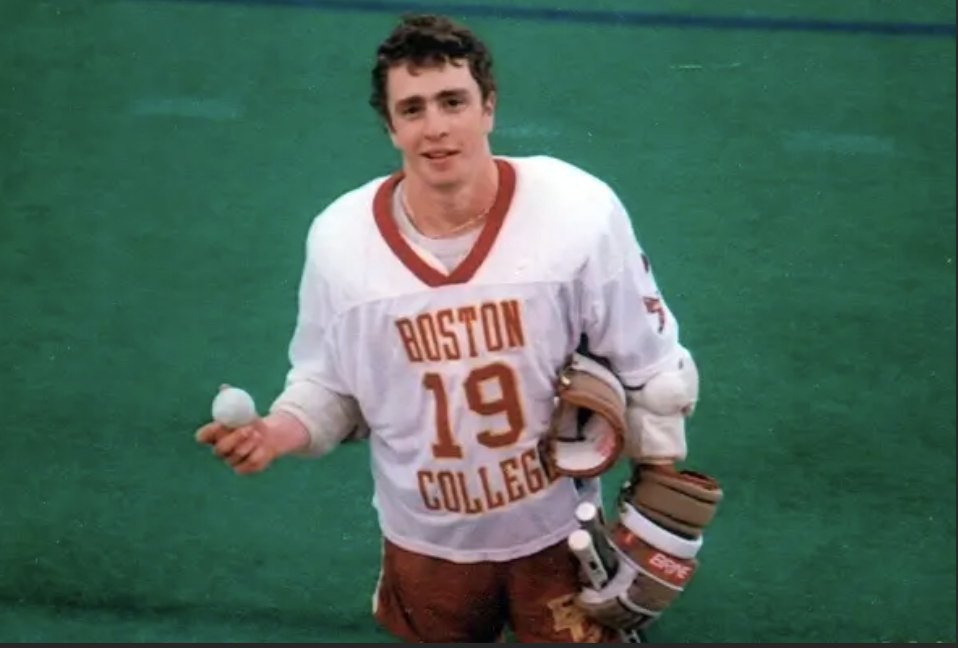
This oral history interview features Alison Crowther, mother of Welles Crowther, who was killed in the terrorist attacks of September 11, 2001. A 24-year-old equities trader working in the South Tower of the World Trade Center, Welles was also a trained volunteer firefighter, following in his father’s footsteps. On that morning, after ensuring his own safety, he repeatedly returned to help others evacuate, carrying and guiding survivors down stairwells while covering his face with a red bandana he had carried since childhood. In this interview, Alison reflects on her son’s life, his character, and the extraordinary courage that defined his final hours.
This interview is part of an oral history project undertaken by Alex Bower-Leet in affiliation with the University of Kentucky.
I’m a mom and a grandmother now. My husband passed away about seven years ago. 9/11 killed him as much as it killed my son, it just took a lot longer. He was quite ill in the end. At any rate, I am living here on the property that we raised our family. My younger daughter, Paige, who was living in Massachusetts, married a fellow from New Bedford, Massachusetts, they had their second baby and asked, “Mom, can I come home and take over the main house?” I have a cottage here in the back where my parents lived for a number of years when I was taking care of them. So I’m in the cottage and they’re in the main house and I’m surrounded by family. My other daughter, Honor, who is older, was close in age to Welles and very close as well, lives in the next town over. So I feel like it’s like one friend of mine said, all my little chicks are gathered around me. It’s a beautiful thing. Well, it’s really nice, right? It’s really important. And they’re wonderful. They’re all wonderful. So I have grandchildren. My oldest is 21 and graduating from college this year and hoping to go to veterinary school. And my youngest is also a little girl. I have three grandsons and three granddaughters. The youngest is also a little girl. She’s five and in kindergarten. So I have a whole range of wonderful ages and they’re all unique and beautiful. So I’m very fortunate.
Life Before 9/11
Before 9/11 was just glorious. Everything was beautiful. I was working for a company in direct sales. I was vice president of sales for a company in Westchester County. and enjoying that work very much. My husband was a banker in the city and commuting into New York on a pretty regular basis. My Welles had graduated from Boston College and was living this dream life, where he was an equities trader, something he had wanted to be for many, many years. And he had a lot of great friends, was having a lot of fun in New York. He said, “Mom, I’ll take you anywhere, anywhere you want to go. I will go and take you.” It was so sweet. Honor was in Boston College. She was a senior at the time. She also was a lacrosse player at Boston College, and made great friends on the lacrosse team. Sports was a great way for Welles to make enduring friendships through high school, growing up in high school here in this area and also at Boston College. He made lifelong friends there that are still friends today. And stay in touch. They’re very supportive of our work for our Welles, the Welles Remy Crowther Charitable Trust. So Honor, before 9/11, was at Boston College and enjoying life there very much. She also was an excellent student. And when she graduated, she went to work locally for a family, a very well-to-do family here over in Westchester County. And that’s where she met her husband to be Rick Fagan. Honor was accepted at St. John’s Law School on a $20,000 a year presidential scholarship. Very, very fine students, all of them. And so Honor was matriculating there and enjoying law school very much. That was the summer, late spring and summer of 2001. She was in law school for a month when 9/11 happened. Our younger daughter, Paige, also had many friends growing up. She also went on to Boston College, but she had been training as a classical ballerina at a very high level with people from the Bolshoi and Russia and New York City Ballet principals and American Ballet Theater principals. She was really just having a splendid run there, but then decided to go on to college. So she went to Boston College. It was her senior year in high school when 9/11 happened in that fall. So we had a full happy family life.
One of my passions was raising boxers, beautiful championship boxers, world class, actually. And the children loved to help me with that. My husband did too, somewhat reluctantly, but he also helped. And every now and then I run into now a grown gentleman or gal that remembers a first grade or second grade trip up here to see puppies that had just been born in our kitchen. I’m a violinist. I still play today with orchestras. And so that’s very satisfying. I was a member of the Junior League of Westchester and Hudson for many years and did a lot of volunteer work with that. So, it was just a big, happy, beautiful family. I’ll never forget the summer of 2001. I just woke up one morning and was so filled with joy about the fulfillment of being a parent, to have three wonderful children thriving and living their beautiful lives in such a productive and successful way. And then 9-11 happened and shattered so much.
I have to say [the drive for their success] may be genetics to a certain extent. My husband’s family were all very successful, highly intelligent, successful people in different fields. My husband’s father was Bosley Crowther, who was a film critic for the New York Times for 40 years, a very famous gentleman in that world. And there were successful business people in many fields on both sides of my husband’s family, in real estate or business. My side of the family were medical people and engineers, also very high functioning. My father was a dentist, my grandfather was a dentist, my mother’s father was an engineer and very high up in management with the A&P, the Atlantic and Pacific Tea Company. One of her brothers ended up spending his career in India, in Bombay and New Delhi, and then Manila as head president of the Exxon Oil Company in Manila. My other uncle, my mother’s younger brother, also a chemical engineer. All college educated, all of them. He was a big wig with Pfizer. So when Pfizer came out with the first vaccination for COVID, I called my uncle up, he had been long retired, and I said, “I’m so proud that our family is connected through you to this amazing company that’s saved the world through their research.” And Moderna and others, those two main ones, but Pfizer was that connection. So we valued education highly. I know I was a hard worker. My husband was also a hard worker, but he knew how to relax. I’m not so sure I know how to relax. So it’s probably a bit of an example, I’m sure there’s an example set there as well. But this is how they were raised by our families, all around us were well-educated, high-functioning. My husband’s brother was Princeton, all that side of the family, Princeton graduates and my family’s father’s side, NYU graduates and dental school and my, my mother’s brothers, Lafayette, my mother went to Skidmore, my grandmother went to Smith College. So, it was part of our fiber to be well-educated, hardworking and well-educated. Education is so important, so very, very important.
And support. I mean, we always felt supported. We were always surrounded by positive energy. You know, you can do anything you put your mind to. I heard that over and over again. Nobody was tearing us down. Nobody, and there are so many people suffering from that these days it seems, either through family who aren’t hard working or not supportive or having their own issues or bullying on social media, things that really chew on people’s self-esteem. And life is pretty hard. So that is very destructive. And so I was blessed and I tried to carry that on to my children, always with a positive attitude or helpful if they were struggling with something to help them and support them in anything they wanted to do.
In fact, the last conversation I had with Welles was Labor Day weekend of 2001, and he seemed to be very melancholy. Now, I don’t know, maybe he was, there are all kinds of ways of looking at this, but on the surface that is what I was seeing at that moment. Welles was like going over all of his old albums, visiting the places of his life growing up and absorbing everything. He just was a big sponge, absorbing his family and his youth. And I remember talking to him right before taking him into the city. And I was driving across the Tappan Sea Bridge. He said, “You know, mom, there’s something happening,” or something to that effect. And I thought he just wanted to change jobs and go to graduate school or something. So I said, “Welles, whatever you want to do, we will support you in whatever decision that you want to make.” I remember saying that to him.
I’m so strong. I mean, like, I’m very thankful too, because my family is very, very supportive. And I’m very thankful that my parents supported my brother and I over the years. And I’m very thankful that they have given me the opportunity to go to grad school when some people have to pay it out of pocket. I’m very thankful that my parents were very supportive of education and everything that we do.
There was always a saying that my grandfather would throw around called, just because you fell off the horse, you can always ride it again. That was always something I would always say to myself, if I got knocked down.
Welles’ and Alison’s Response to 9/11
I was at work when 9/11 happened. And I mean, there are other things that happened beforehand, but I won’t go into that here. I’ll probably be writing a book about it someday. But anyway, I was at work at my position. I was sitting with the president and owner of the company, the founder of the company, Holbrook Cottage. It’s based in Briarcliff Manor, which is a sweet, lovely town in Westchester County. And we were sitting together planning, starting to plan a sales meeting, our fall sales meeting. And her phone rang. Her husband was a stockbroker and still is in Manhattan.
Her phone rings and she answers and says, “Allison, it’s for you. It’s Jeff’s,” my husband’s name was Jeff for Jefferson, “It’s for you. It’s your husband’s secretary.”
I said, “Oh, why? Wow, why should she be calling me?” So I got up to go into my office. My husband was planning to go on a golf outing that day. Bankers do that quite a lot, take clients and go to golf outings and that sort of thing. So I thought maybe something had happened to Jeff. So I answered my phone in my office and his secretary said, “Allison, Welles just called. He wants you to know he’s okay.” Now, this was the morning of September 11th, a little after nine.
And I said, “Welles, why wouldn’t he be okay?”
And she said, “Haven’t you heard?”
I said, “Heard what? She said, the World Trade Center’s been hit by a plane. So I, probably like everyone else except the planners of this terrible event, thought oh, it must have been a small plane out of control, too bad for them. Then she hung up.
And then we got the news that the second tower had been hit. We still didn’t know which towers were hit. And at work we didn’t have a television so they found an old radio. So they were able to get that going and listen. And then the reports came over that one of the towers had collapsed. The minute I heard that, I knew in my heart of hearts Welles was gone. I don’t know why, just mother’s instinct, and in fact that was the case. It was the South Tower that came down first and Welles was in the South Tower. And so I called my husband really upset and my husband was trying to stay calm and say, “Don’t say that. He had plenty of time to get out. Let’s be hopeful that he was able to get out and don’t jump to any conclusions.”
So some people at work drove me home, which was wonderful. My daughter Honor was up in northern Westchester and her then boyfriend, now husband, drove her home. He told me that when crossing the bridge, he stayed on the north side of a big tractor trailer all the way across the bridge. So Honor couldn’t see the smoke coming from the tower. We still didn’t know if Welles was lost or not. And Honor told me that’s when she started composing her eulogy for Welles, which was beautiful. Anyway, she was an English major at Boston College and writing, superb writer. So my people got me home and I just remember I was in total shock because by then both towers had come down and I’m sitting looking at a television trying to search for Welles. I mean, I basically started that morning looking for Welles. I was hoping to see him walk by in the smoke and the debris because there were a lot of people they showed walking. That was the start of my search for him that very day. And I just remember sitting there thinking, this is going to be like putting together a big jigsaw puzzle of what went on inside those buildings and what happened. So in fact, that’s what it was. And in the end, that’s how I found Welles, identified him through the jigsaw puzzle that four New York Times writers had put together for a big article called “Fighting to Live as the Towers Died” that came out the following Memorial weekend.
So that was my morning. And basically, I didn’t eat for a week. I don’t think I drank water. I walked. I was concerned about my daughters, that they weren’t thrown off the rails by what happened. And also all the young people. My husband seemed strong. He was going into the city to give toothbrushes and hairbrushes of Welles for DNA samples, all the things that we had to do as a family to help with the ultimate identification of our loved ones, many of whom still have not been identified, which is a terrible thing. So he seemed like he was soldiering on. You know, in my mind, we were the adults, we were the ones that had to be strong and had to take charge and make sure everybody else was okay. And so my husband buried a great sadness and loss deep, deep inside of him, and it chewed on him for the rest of his life and it was very destructive for him emotionally. So that is what we did in the couple of days that followed, we opened our doors to the young people, Welles’s friends because we heard that they were flying in from Canada and California and coming back and staying in homes around us. So I said, you know what, let’s just open our doors. And we left our front door open for a week. And kids were coming in, staying with us, spending the days with us. It was such a beautiful thing.
The Empire Hook and Ladder Company had set up, we had a service for Welles two weeks later, and Empire, Hook and Ladder, they brought us food. People were leaving food at our front door. And so it was like the loaves and fish dishes. It didn’t matter how many people came to our door. We always had food for them and time for them. And it was just an amazing outpouring of love and compassion. Empire set up a big reception, dinner reception after Welles’ memorial service that we had about, two weeks later. So that was that. That’s how we dealt with it. And then we just kind of marched on. And to this very day, we have things we have to be doing that are related to Welles and related to 9/11 and keeping up with the victims compensation fund, we families were given a big, huge settlement of which we’ve received just a tiny little bit. And, here it is 25 years later and still fighting a lawsuit against the Kingdom Saudi government for their complicity in this, which it’s been documented, you know, people in their government were in contact with the terrorists. So it’s not politically expedient, apparently, to hold the Saudis accountable. And that’s really unfortunate. So that’s kind of my experience.
After 9/11
There were people just sending us money. And actually, we got a check for about, I think it was about $13,000 from a collection of fire companies up throughout Maine, I believe. And we said, we don’t need this money personally. We should start a charitable trust. My husband’s oldest brother is an attorney. He’s sadly passed away now.. And he said, let’s set up the Welles Remy Crowther Charitable Trust, and he kept the money in, we just sent all the checks to Bosley, and he kept them in an escrow fund until we could actually, officially create a 501c3, which we did. We had a friend who was an attorney up here who did that for us. But it took a while. So I don’t know, it was just something that we right away knew we needed to do to remember Welles. And the mission was pretty much to help young people. And so that really evolved into our mission statement, which is to assist young people to be exemplary adults through education, health, recreation, and character development. So those qualities, that framework is how we do most of our donating now. And thanks to, you know, in the beginning, Welles’s friends were setting up fundraisers, and it was something that made them feel good because they felt they could do something positive in Welles’s memory. And that was wonderful. And then Boston College started a family who had been very big donors at Boston College. Buildings are named after them. The husband had five children. One of his daughters was in Welles’s class and that family fund donated $1,000,000 to Boston College to establish the directorship of the Volunteer and Service Learning Center at BC. Boston College’s big mission for service. And I think it’s about 30% of their student body is involved with service projects in some form. And so the Volunteer and Service Learning Center is an important, important organization there.
And so my daughter Paige was in college at the time, and I think it might have been her junior year. It was around 2006, I guess. That was her senior year, she graduated, 2005, 2006. I heard about this, so I went up to meet the new director, Dan Ponsetto, And two of Welles’ friends had decided to run in the New York City Marathon and raise money by selling cookies. So they raised about $1,000 and that was wonderful.
And so, Dan said to me, “Well, what can we do for you?”
I said, “Isn’t this enough? This is amazing. You know, the service volunteer and service learning centers, the directorship’s been named in Wells’s honor. That’s enough.”
He says, “No, No, we can do more.”
So I said, these two young ladies just ran in the New York City Marathon. Maybe, through the BC network, we can get other people to run in the New York Marathon, which was a terrible idea, ridiculous, but that’s all I could come up with.
And so Dan said, “Well, why don’t we do a run right here on campus?” And so that was the birth of the Red Bandana Run at Boston College, which has been incredible.
And it grew. The first year it was like 235 runners, I don’t know, 250, 270, 300, yay, 400, yay. Then another friend of Welles’ who was working for ESPN, Drew Gallagher is his name, reached out to us and said, I’d like to do a documentary on Welles. Well, that happened. ESPN for the 10th anniversary, ESPN launched the 13 minute documentary in New Zealand of all places. That’s where they started out.
And so with that, the runners went from like 400 to like I don’t know, 1,200. It was just this huge leap of an extra 1,000 runners. And it has continued to grow ever since. So there were typically around 1,800, 1,900 runners. And it’s our single largest fundraiser for the charitable trust. And that’s what really keeps our engines turning. And so do big donations from the Fetzer Institute and now Empower to help us develop and refine and digitize our Red Bandana Project lessons, which are social and emotional learning lessons on leadership, caring for others, teamwork, the power of one, bridging divides, bringing different groups together to understanding, forgiveness, and carpe diem. There’s seven lessons in this. And so now we have the middle school lessons. They were developed for elementary school, middle school, high school, sports teams, and camps and youth programs. And now we have the middle school lessons updated. And this was done 10 years ago. So now they’re updated and the middle school lessons are updated and digitized on our website for anyone to download and implement. We’re in 36 different states now. In a couple of cities in Canada, New Zealand, I believe, Scotland, the lessons are being utilized around the world, which is really incredibly wonderful.
Our website is wellscrowthertrust.org, www..wellscrowthertrust.org. So anyone can check into that. And sign up for some lessons if they wish. All they have to do is register their name and e-mail and what state they’re in. So that’s been very exciting. Plus we give a lot of money to really important projects, some scholarships, but also we support other organizations that help young people. So The Wild Center is one that’s a beautiful Natural History Museum of the Adirondacks. We support that and the youth programs there for education. You know, it’s lacrosse programs, of course, Boys and Girls Clubs. You know we don’t have to reinvent the wheel. We did that with these character lessons. So we like to support the good work of others as well.
I like to say Welles is still in charge up there. I do believe that. And every fall I get lots of letters because teachers are teaching about Welles to their students at all these elementary, middle and high school levels. And every year I get packets of manila envelopes filled with letters and artwork from these students. And that’s absolutely so beautiful for us to see how Welles’s example and story and legacy, 25 years later, still continues to impact and influence and inform and develop young people. It’s fantastic to me. And the teachers who are teaching this, very special.
How Do We Continue to Honor 9/11
I think it’s important to always remember the event and the lives lost and the horror of it. The students now, this is history. So they didn’t viscerally experience the horror and the 9/11 attack on civilians using aircraft in this way, it really changed the world and showed the world the inhumane level to which terrorists and sociopaths, which these people were, will sink to. Who knows even if all they wanted to do was hurt Americans. You know, when I was in college back in 1968, I attended Wheaton College in Norton, Massachusetts, and I was taking a course in international relations. I love that sort of thing. And our professor was an Englishman, Professor Adrian Well Vaughan. And one morning we’re sitting in class and he said, “Ladies, who do you think your greatest enemy is?” And so, of course, you know, we were Cold War babies, so we all thought the Russians, which probably is still true to a certain extent, sadly.
But anyway, who’s your greatest enemy? And so we said, well, Russia and the USSR at that point, and he shook his head and he took a piece of chalk and wrote on the chalkboard, J-I-H-A-D. This is your greatest enemy. This movement wants to destroy you. And we looked at that because jihad, jihadism, we had never really known about it much. And I thought at the time, well, that’s pretty frightening, but they’re all the way around the world. How can they hurt us? And on 9/11, I found out. It’s extremist. I spent a week almost in Jordan visiting and attending a two-day conference that was hosted by the Salam Institute for Interfaith Studies, which is based in Washington, D.C., and the Royal Institute, the Royal Institute for Interfaith Studies. And in Jordan, Christianity and Islam are side by side. I met Prince El Hassan bin Talal, who was the brother of the late King Hussein, who was Harvard educated and about my generation. So he knew all about flower children in California. They all do beach boys and all that kind of thing. Very enlightened.
So at this conference in Amman, Jordan, I was invited to speak about Welles and the purpose of it was to try to study how they can develop their children to be more compassionate and caring of others. There were representatives from five different Arab countries, business leaders, and religious leaders. There were Protestant ministers there. I sat next to the primate of the Greek Orthodox Church. And there were moms and all kinds of people at this meeting, and business people as well, and governmental people. It was just fabulous.
And each one of the speakers who were Islamic condemned the attackers of 9/11. And they said they’re sociopaths and criminals, and they have nothing to do with our religion. And that’s really what it is. So my hope is that moving forward from September 11th, we cannot forget how vulnerable we were to allow this to happen, to start with, and to protect our country more, which has been happening so something like this won’t ever happen again. But also to move toward an openness toward understanding and respecting others and working together rather than being so divisive and these wars that are so terrible. And be strong to stand up against things that are so wrong.
For example, like what’s going on in Ukraine right now. Gaza seems to be under control. There was a purpose to that, to protect Israel. But also, you know, there are limits and so many people suffer unnecessarily. You know, just as a world, a country, we need to come together to really prevent atrocities from happening. We should be far more advanced than that as a creature living on this fragile earth. So that’s my hope, is that after 25 years, let’s really focus on how we can work best together as countries around this world to make this whole world a better place. Not just have poor people ruled by tyrants and sociopaths. And it’s just sad to me that that exists.
Something I say to students, corporations, and adult groups when I travel around the country speaking, when I’m talking about bridging divides, bringing disparate groups together through understanding, I always say, I love this phrase, “Seek first to understand and then to be understood,” because it’s so much easier to get your point across if you understand the people with whom you’re speaking. And it makes communication much more effective and positive, I believe. So, yeah, that’s a very important thing. I’m glad you brought that up.


 Previous